06. 雅思写作全真题库实战演练与分题型写作提纲 (Writing Practice Bank)
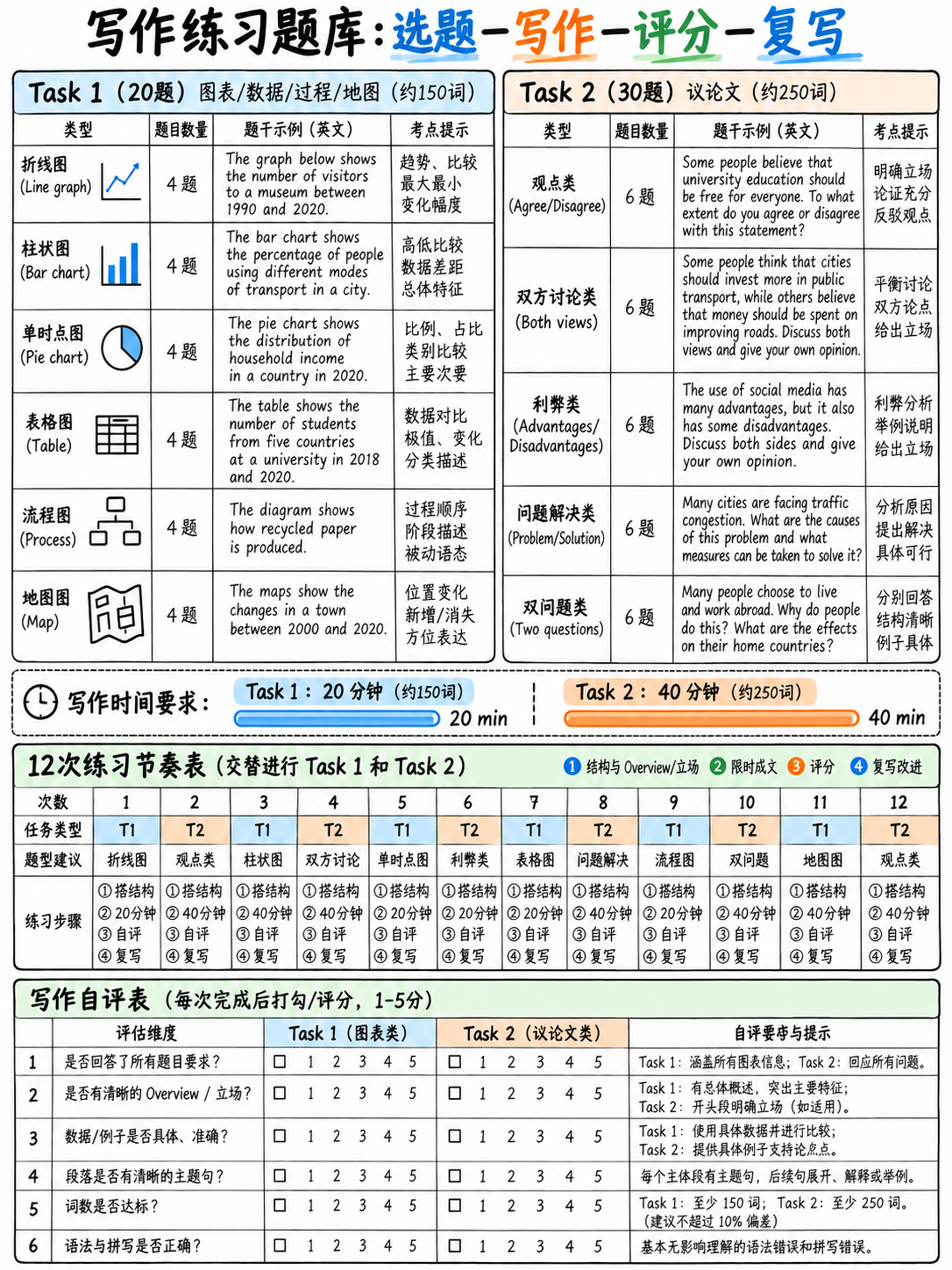
本题库使用原则与考场防押题声明
真实考试中绝不可押题或机械背诵范文!
官方在 2023 年改版评分标准中明确指出,整篇死记硬背的作文将直接判定为 Band 0 [8]。
本题库严格按照雅思官方《Guide for Test Takers》[1] [10] 的学术语体与设问规范编撰,汇集了20 道涵盖所有题型的 Task 1 仿真图表数据集,以及30 道覆盖 12 大常考母题的 Task 2 大作文高频题目。每道题均配以英文题干要求与深度中文审题、逻辑拆解思路,供考生进行高强度限时模拟练习。
1. Task 1 全真模拟题库 (20 套全题型数据集与分组指引)
所有题目均包含文字化数据表格或工艺流程清单,无需看图即可在屏幕上随时展开限时 20 分钟作答。
动态趋势线图与柱状图 (Tasks 1–7)
T1-1. 四国国际留学生数量变迁 (表格型动态趋势)
The table below shows the number of international students (in thousands) enrolled in higher education in four countries between 2010 and 2025.
Country |
2010 |
2015 |
2020 |
2025 |
|---|---|---|---|---|
USA |
690 |
975 |
1,075 |
1,020 |
UK |
405 |
435 |
540 |
760 |
Australia |
270 |
295 |
445 |
400 |
Canada |
145 |
240 |
500 |
625 |
破局指引:时间全在过去(过去时)。Overview:四国留学生人数总体均大幅上升;美国全程高居榜首但后期轻微回落;加拿大增幅最为惊人(狂飙超 4 倍)。分组策略:Body 1 写美、英(体量前两强);Body 2 写澳、加(后起之秀,对比加拿大反超澳洲的交织点)。
T1-2. 家庭能源消费结构演变 (多数据动态变迁)
The data below details household electricity consumption (kWh per household per year) in one European country by energy source between 2005 and 2025:
Gas: 11,200 (2005) → 9,400 (2015) → 6,100 (2025)
Electricity: 3,300 (2005) → 3,800 (2015) → 4,900 (2025)
Solar: 20 (2005) → 240 (2015) → 1,650 (2025)
Oil: 1,100 (2005) → 500 (2015) → 150 (2025)
破局指引:Overview:传统化石燃料(天然气与燃油)大幅缩水;清洁电力与太阳能呈爆发式扩张(太阳能激增逾 80 倍)。分组:Body 1 写化石能源萎缩组;Body 2 写清洁电力激增组。
T1-3. 四座城市房价收入比变迁 (Multiples of Annual Income)
The graph outlines average house prices expressed as a multiple of average annual income across four cities between 2000 and 2024:
City A: 4.1 (2000) → 7.8 (2012) → 11.2 (2024)
City B: 3.9 (2000) → 5.1 (2012) → 5.4 (2024)
City C: 6.2 (2000) → 5.8 (2012) → 4.9 (2024)
City D: 2.8 (2000) → 4.0 (2012) → 8.1 (2024)
破局指引:Overview:除城市 C 逆势下滑外,其余三市购房负担均显著加重;城市 A 购房难度翻近三倍并成为最难承受的城市。
T1-4. 城市公共出行方式客运量 (两时期柱状对比)
The bar chart displays passenger journeys (millions) across three transport modes in a metropolis in 2015 and 2025:
Bus: 182 million (2015) → 141 million (2025)
Tram: 64 million (2015) → 128 million (2025)
Bicycle hire: 3 million (2015) → 29 million (2025)
破局指引:Overview:公交车仍维持客运总量第一但唯一出现萎缩;有轨电车客流翻倍,共享单车呈现接近十倍的爆发式增长。
T1-5. 纸媒与网络新闻阅读率消长 (长跨度走势)
The graph compares the percentage of adults reading print newspapers vs. online news at least weekly between 2000 and 2025:
Print newspapers: 68% (2000) → 59% (2005) → 44% (2010) → 29% (2015) → 18% (2020) → 11% (2025)
Online news: 4% (2000) → 17% (2005) → 38% (2010) → 61% (2015) → 74% (2020) → 81% (2025)
破局指引:抓住 2012 年前后的关键交叉点 (Crossover Point)。纸媒断崖下滑,网络新闻强势崛起。
T1-6. 三个地区五十年降水量走势 (Annual Rainfall in mm)
Average annual rainfall (mm) across three geographical zones over five decades:
Northern: 940 → 905 → 880 → 835 → 790
Central: 610 → 640 → 600 → 655 → 620
Southern: 310 → 280 → 240 → 195 → 160
破局指引:北部与南部持续干旱化下降,中部平稳波动。
T1-7. 三大产业劳动力占比演变与远期预测 (1980–2040)
Proportion of workforce in three economic sectors, with future projections to 2040:
Agriculture: 22% (1980) → 9% (2010) → 4% (2040)
Industry: 41% (1980) → 28% (2010) → 19% (2040)
Services: 37% (1980) → 63% (2010) → 77% (2040)
破局指引:注意 2040 年的时态处理(运用 is projected to / is anticipated to)。服务业跃升为绝对主导产业。
单一切片静态图表与双饼图 (Tasks 8–11)
T1-8. 成年人每周闲暇时间分配 (单一年份柱状图)
Weekly hours spent by adults on leisure activities in 2024: Screen-based media: 14.2h; Socialising: 5.1h; Exercise & sports: 3.4h; Reading books: 2.6h; Hobbies: 2.2h; Volunteering: 0.8h.
破局指引:一般现在时。屏幕媒介占据绝对碾压优势,志愿服务敬陪末座。
T1-9. 居民选址购房核心考量动机 (单表格比例)
Survey of 1,000 residents on primary reasons for choosing their home: Proximity to workplace: 31%; Property affordability: 27%; Quality schools: 14%; Closeness to family: 12%; Property size: 9%; Other: 7%.
破局指引:通勤与价格是前两大支配性动机(合占近六成)。
T1-10. 首都单身成年人五项基本月度支出 (生活成本快照)
Average monthly cost (local currency) of five living essentials for a single adult in a capital city: Rent: 1,150; Food & groceries: 320; Utilities: 140; Public transit: 95; Broadband & mobile: 55.
破局指引:租金成本是其他所有生活支出总和的两倍以上。
T1-11. 大学两时期经费收入结构 (双饼图对比)
Sources of university funding in 2005 vs. 2025:
2005: Government grants 62%, Tuition fees 24%, Research contracts 9%, Private donations 5%.
2025: Government grants 31%, Tuition fees 44%, Research contracts 18%, Private donations 7%.
破局指引:公费拨款减半,学费跃居最大资金支柱。
双变量综合表格 (Tasks 12–14)
T1-12. 四个年龄段社交媒体偏好 (两变量大表)
Percentage of users across age groups utilizing three social media categories in 2024:
Age bracket |
Short-form video (%) |
Instant messaging (%) |
Professional networks (%) |
|---|---|---|---|
16–24 |
91 |
96 |
22 |
25–39 |
68 |
94 |
61 |
40–59 |
34 |
81 |
48 |
60+ |
12 |
54 |
11 |
T1-13. 五国人均垃圾产生量与循环回收量 (对照表)
Annual municipal waste generated and recycled per capita (kg) in five countries:
Country A: 530 generated / 185 recycled
Country B: 410 generated / 240 recycled
Country C: 780 generated / 160 recycled
Country D: 290 generated / 95 recycled
Country E: 610 generated / 430 recycled
破局指引:对比垃圾总量与回收转化率(Country E 回收率超 70%,而 Country C 垃圾最多但回收率极低)。
T1-14. 三国学生学段家庭作业时长对比 (跨学段表)
Weekly homework hours across three school levels:
Primary: Country A (3.1h), Country B (1.2h), Country C (5.8h)
Lower Secondary: Country A (6.4h), Country B (3.9h), Country C (12.1h)
Upper Secondary: Country A (9.0h), Country B (7.2h), Country C (18.5h)
流程图与工业周期 (Tasks 15–17)
T1-15. 市政自来水净化处理八步工序 (Drinking Water Treatment)
Water pumped from reservoir → 2. Coarse screening removes debris → 3. Chemical coagulation clumps particulates → 4. Sedimentation tank settling → 5. Sand filtration → 6. Chlorination disinfection → 7. Covered storage reservoir → 8. Municipal delivery to homes.
破局指引:全篇一般现在时被动语态。分物理过滤与化学消毒两阶段。
T1-16. 智能手机循环生命周期 (Mobile Phone Life Cycle)
Raw mineral extraction → Component manufacturing → Factory assembly → Global retail distribution → Consumer use (avg 2.5 years) → Disposition (trade-in / hoarding / landfill) → Refurbishment / Raw material recovery → Re-entering manufacturing stream.
T1-17. 商业面包流水线烘焙工艺 (Commercial Bread Baking)
Ingredient mixing (flour, water, yeast, salt) → First proving (1 hour at 27 °C) → Mechanical dividing & moulding → Second proving (45 min) → Oven baking (30 min at 230 °C) → Rack cooling (2 hours) → Automated slicing & packaging → Dispatch to supermarkets.
地图变迁与城市空间规划 (Tasks 18–20)
T1-18. 大学校园三十年规划变迁 (1995 vs. 2025)
1995: West: Library; Centre: Science block; East: Admin; South: Open surface car park; North: Playing fields.
2025: Car park replaced by student halls & landscaped plaza; Science block doubled; Sports centre occupies east playing fields; Library unchanged; Pedestrian walkway connects all units.
T1-19. 老城商业中心步行化改造 (Before vs. After Redevelopment)
Before: East–west throughway carrying heavy traffic with shops on both sides; North: Market square; Southeast: Abandoned textile factory.
After: Main street pedestrianised; Traffic redirected to new southern bypass; Derelict factory converted to cinema & parking complex; Four retail stores converted to cafés; Market square preserved.
T1-20. 热带岛屿旅游综合体开发前后 (Natural Island vs. Tourist Resort)
Before: Small fishing village on north shore; Single dirt track; Pristine west beach; Dense interior forest.
After: Village expanded threefold; Large hotel resort behind west beach; Boat pier on north coast; Paved circular ring road; Forest area halved.
2. Task 2 全真大作文高频母题库 (30 道精选题及审题指引)
题型 1:观点态度类 (Opinion: Agree / Disagree) — 题号 1–6
公共文化投入:Some people think that governments should spend money on public libraries rather than on digital services. To what extent do you agree or disagree?
• 核心提纲:探讨数字鸿沟、社区实体文化空间的不可替代性 vs 数字化资源的高效普及。人工智能与就业:Artificial intelligence will do more harm than good to the job market. Do you agree or disagree?
• 核心提纲:自动化带来的阵痛与岗位替代 vs 新兴高阶岗位的诞生与整体生产力释放。实用技能入课堂:Children should be taught practical skills such as cooking and personal finance at school rather than additional academic subjects. To what extent do you agree?
• 核心提纲:成年生存基本素养 vs 学术基础对高等教育的基石作用(平衡折中立论)。轻罪惩戒与改造:The best way to reduce crime is to give young people education and employment rather than longer prison sentences. Do you agree or disagree?
• 核心提纲:溯源治理与消灭犯罪温床 vs 严刑峻法的社会威慑作用与受害者正义。全民高等教育免费:Universities should charge no tuition fees at all. To what extent do you agree or disagree?
• 核心提纲:促进社会公平阶层流动 vs 财政过载导致大学科研教学质量下滑与文凭通胀。现代健康危机:People today are less healthy than people were a hundred years ago. To what extent do you agree?
• 核心提纲:现代医学与人均寿命飞跃 vs 久坐生活方式、加工食品与心理焦虑慢性病。
题型 2:双边讨论类 (Discussion: Both Views + Opinion) — 题号 7–12
远程居家办公:Some people believe that working from home benefits both employees and employers, while others think it damages productivity and workplace relationships. Discuss both views and give your own opinion.
• 核心提纲:灵活性与通勤成本消除 vs 团队协同损耗、企业文化缺失与员工职业倦怠。公共博物馆门票:Some argue that museums should be free for everyone; others say visitors should pay an entry fee. Discuss both views and give your own opinion.
• 核心提纲:文化普及与公众教育权益 vs 维护珍贵文物馆藏的巨额资金需求。治堵手段之争:Some people think the most effective way to reduce car use is to improve public transport; others believe it is to make driving more expensive. Discuss both views and give your own opinion.
• 核心提纲:正向激励(便利公交)vs 负向经济惩罚(拥堵费/高油税),得出“双轨并行”结论。文理科目价值:Some believe history should be a compulsory school subject; others think the time would be better spent on science and technology. Discuss both views and give your own opinion.
• 核心提纲:历史塑造人文批判性思维与文化认同 vs 科技工程是现代经济核心驱动力。社交网络言论监管:Some people think social media companies should be held responsible for the content on their platforms; others believe users themselves should be responsible. Discuss both views and give your opinion.
• 核心提纲:算法助推与企业把关人责任 vs 个人法律责任与言论表达自由。减贫路径分歧:Some argue that economic growth is the only way to reduce poverty; others say that income redistribution matters more. Discuss both views and give your own opinion.
• 核心提纲:“做大蛋糕”(增长创造就业)vs “切好蛋糕”(税收二次分配与社会安全网)。
题型 3:利弊分析类 (Advantages & Disadvantages) — 题号 13–18
青年独居风潮:More and more people are choosing to live alone in modern cities. What are the advantages and disadvantages of this trend?
• 核心提纲:个人生活自由度、专注度 vs 孤独感增加、社会连带减弱与单人住房成本高企。雇主线上监控员工:Many companies now monitor their employees’ online activity and keystrokes. Do the advantages of this outweigh the disadvantages?
• 核心提纲:防范数据泄露与确保工时合规 vs 摧毁劳资信任、制造心理压力与侵犯隐私。全球大众旅游扩张:Tourism has become one of the largest industries in the world. Do its benefits outweigh its drawbacks?
• 核心提纲:创汇就业与跨文化交流 vs 脆弱生态破坏、过度旅游导致的物价飞涨与文化异化。跨国留学热潮:An increasing number of students pursue their higher education abroad. Do the advantages outweigh the disadvantages?
• 核心提纲:全球视野与语言学术沉浸 vs 昂贵开销、文化休克与发展中国家人才流失。市中心全面禁车:Some municipal governments have banned private motor vehicles from city centres. What are the advantages and disadvantages of such a policy?
• 核心提纲:空气清新、慢行友好与事故锐减 vs 商户物流受阻、郊区居民通勤不便。幼儿拥有智能手机:Many children now have their own smartphone before the age of ten. Do the advantages outweigh the disadvantages?
• 核心提纲:紧急联系与启蒙教育应用 vs 屏幕沉迷、注意力涣散、网络欺凌与近视率激增。
题型 4:问题与对策类 (Problem / Cause & Solution) — 题号 19–24
城市核心区住房危机:Many city centres are becoming unaffordable for ordinary workers. What problems does this cause, and what could be done about it?
• 核心提纲:职住分离、长途通勤加剧拥堵、关键公共服务人员流失 vs 兴建保障性公租房、地价管控。发达国家食物浪费:The amount of food wasted in developed countries is increasing alarmingly. Why is this happening, and what measures could reduce it?
• 核心提纲:超市严苛外观分级、过度采购冷链不当 vs 临期食品捐赠立法、普及公众按需消费教育。青少年缺乏体育锻炼:Levels of physical activity among young people are falling sharply. What are the causes, and what can be done?
• 核心提纲:电子屏幕诱惑、学业压力过大、活动场地匮乏 vs 强制课间锻炼、社区建设免费体育运动设施。濒危语言加速消亡:Many indigenous languages are disappearing at an unprecedented rate. Why is this happening, and does it matter?
• 核心提纲:全球化与主流通用语同化 vs 语言承载着独特的非物质文化遗产与人类认知多样性。城市空气质量恶化:Air pollution remains a critical health threat in many large urban centres. What are the main causes, and how could it be reduced?
• 核心提纲:燃油汽车尾气排放与工业外溢 vs 淘汰老旧燃油车、补贴新能源与搬迁重污染工业。青年心理焦虑蔓延:Rates of anxiety and depression among young adults have surged. What do you think are the causes, and what solutions can you suggest?
• 核心提纲:职场内卷无常、社交媒体虚荣攀比 vs 建立校园心理咨询绿色通道、提倡健康工作制。
题型 5:复合直接提问类 (Two-Part Direct Questions) — 题号 25–30
社交媒体成新闻主渠道:Many people now get their daily news from social media rather than traditional outlets. Why is this happening? Is it a positive or negative development?
• 核心提纲:算法即时推送与互动便利性 vs 信息茧房、虚假新闻泛滥与公信力崩塌。部分国家生育率断崖:In some countries, birth rates have dropped to historic lows. What are the reasons for this? What effects might it have on society?
• 核心提纲:育儿成本高企与女性职业追求 vs 老龄化严重、养老金缺口与劳动力枯竭。二手消费热潮:More people are choosing second-hand goods over brand-new ones. Why do you think this is happening? Do you consider it a positive trend?
• 核心提纲:环保意识觉醒与消费理性回归 vs 减少碳足迹与促进循环经济发展。延迟法定退休年龄:Some governments encourage citizens to work beyond the official retirement age. Why might a government do this? Is it a good idea?
• 核心提纲:缓解养老财政亏空与应对劳动力短缺 vs 挤占年轻人上升通道,需视工种灵活自愿。电商冲击实体街区:Online shopping has replaced a vast number of traditional brick-and-mortar stores. What are the reasons for this, and what effects has it had on communities?
• 核心提纲:足不出户的比价便利与极速物流 vs 实体街区衰败、邻里纽带瓦解与线下就业萎缩。政府全额补贴托育服务:Some governments now provide completely free early-years childcare. Why might they do this? Who benefits most?
• 核心提纲:释放女性劳动力与提振生育意愿 vs 双职工家庭与低收入群体受益最为深远。
3. 考前冲刺 12 课时写作集训日程表 (The 12-Session Programme)
训练单元 |
训练任务与题号 |
核心突破技能点 |
严苛自查红线 |
|---|---|---|---|
第 01 课 |
T1-1 (留学生变迁表) |
四段式骨架与无数据 Overview |
Overview 中绝对不能包含任何阿拉伯数字 |
第 02 课 |
T1-4 (客运柱状对比) |
动态增长与缩水对比句式 |
包含至少 4 个横向对比句 (whereas/compared to) |
第 03 课 |
大作文 Prompt 1 (观点态度题) |
引言段 Thesis Statement 开门见山 |
读完开头段考官即可获知作者明确立场 |
第 04 课 |
T1-15 (自来水流程图) |
一般现在时被动语态与工序推进 |
所有工序动词均为被动语态;克制使用连接词 |
第 05 课 |
大作文 Prompt 13 (利弊题) |
两大主体段篇幅对等与 PEEL 闭环 |
每个主体段至少包含 2 句内在逻辑因果解释 |
第 06 课 |
T1-5 (纸媒与网络走势) |
科学分组(形态分组而非截断时间) |
绝不能按“前十年一段、后十年一段”强行切断 |
第 07 课 |
大作文 Prompt 7 (双边讨论题) |
三大法定任务闭环 |
正方观点、反方观点、个人立场均有充分展开 |
第 08 课 |
T1-18 (大学地图变迁) |
方位词与“未改变之物”对比 |
必须明确指出南部树林完全未变的客观事实 |
第 09 课 |
大作文 Prompt 19 (问题对策题) |
对策落地与明确施策主体 |
对策必须明确指出是政府、学校还是社区来做 |
第 10 课 |
T1-12 (社交媒体复杂表) |
从 12 个数据中挑选 4 个核心特征 |
杜绝流水账报账,提炼年龄反比与全民普及特征 |
第 11 课 |
大作文 Prompt 25 (复合双问) |
严格对应:一个问号一段正文 |
两个主体段分别回答“为什么”与“是好是坏” |
第 12 课 |
任意 Task 1 + 任意 Task 2 |
全真 60 分钟高压双卷实战模考 |
Task 1 严格在第 20 分钟强行交卷!绝不拖延 |
4. 考生独门利器:考场 11 项机械自评分打分表 (The 11-Point Rubric)
完成模拟练习后,不要依赖虚无缥缈的主观感觉。对照以下 11 项客观硬指标进行打分(每项满足得 1 分):
序号 |
机械硬指标检验项 |
得分 (0/1) |
|---|---|---|
1 |
字数达标:Task 1 ≥ 150 词,Task 2 ≥ 250 词(无抄写题目原话充数) |
[ ] |
2 |
段落清晰:严格分为四段,且段落之间有明显的空行 |
[ ] |
3 |
小作文 Overview:第二段是宏观概述段,且没有包含任何具体数字 |
[ ] |
4 |
小作文数据绑定:主体段提及的每一个趋势均有真实数字支撑 |
[ ] |
5 |
大作文开头亮明立场:引言段第二句清晰写出了 Thesis Statement |
[ ] |
6 |
大作文任务全覆盖:数清了所有问号与指令,没有任何漏答 |
[ ] |
7 |
大作文 PEEL 闭环:每个主体段均有“观点 + 机制解释 + 具象案例 + 回扣” |
[ ] |
8 |
连接词克制:大作文全篇显性连接词总量在 8 个以内,绝无连环套话 |
[ ] |
9 |
文体格式纯正:全篇无任何 Bullet points、数字列表或箭头笔记 |
[ ] |
10 |
标点零车祸:无任何 Comma splice(逗号串联两单句),专有名词大写 |
[ ] |
11 |
语法三要素复核:可数名词单复数、现在时动词三单、冠词 a/an/the 均核对无误 |
[ ] |
得分 9–11 分:机械维度已全面达到 Band 6.5–7.0+ 的高分标准!
得分 6–8 分:处于 Band 5.5–6.0 徘徊区,暴露出部分机械性坏习惯。
得分低于 6 分:问题不在于英语词汇水平,而在于写作纪律涣散,请立即重读 01. 雅思写作评分标准拆解:四项维度、字数红线与反模板避坑 (How Writing is Scored)!
上一章: 05. Task 2 各分段(Band 4/5.5/6/7.5)真实考生范文对比与考官逐字评析 (Task 2 Worked Examples) | 下一章学习指南: 01. 雅思学术类阅读评分体系、时间管控与三篇文章通关节奏 (Reading Scoring & Tactics)