02. Task 1 学术类图表报告:四段式结构、Overview 核心法则与数据选取 (Task 1 Academic)
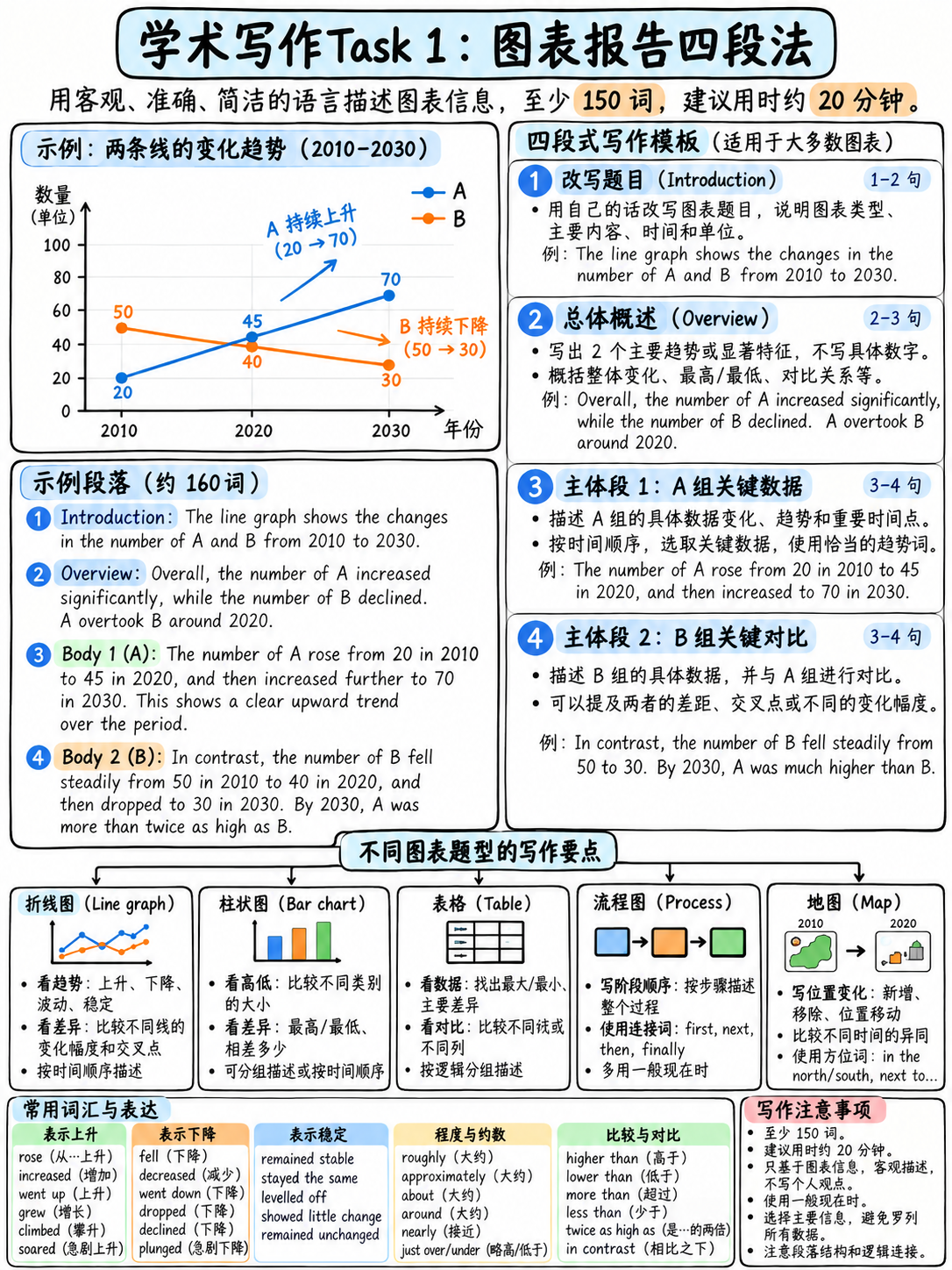
Task 1 核心参数与任务性质一览
核心指标 |
官方标准要求 |
备考战略与考场定位 |
|---|---|---|
建议用时 |
严格限制在 20 分钟内 |
20 分钟必须强制交卷/切换至大作文,绝不恋战 |
最低词数 |
至少 150 词 (≥ 150 words) |
建议黄金词数区间:170–190 词,既充分覆盖又防超时 |
分值占比 |
约占整个 Writing 卷面分的 1/3 |
属于典型的“投入产出比极高、靠套路即可稳拿 6.5–7.0”的题型 |
题目性质 |
客观学术信息转述任务 (Information-transfer task) |
严禁任何个人主观臆断、原因脑补或评价抒情 |
考查题型 |
线图、柱图、饼图、表格、地图、流程图、混合图 |
掌握一套通用的四段式逻辑,万变不离其宗 |
1. 为什么 Task 1 是雅思考试中最容易拿高分的单项?
官方《Key Assessment Criteria》[10] 对学术类 Task 1 的定义,值得每一位考生反复精读:
“This Writing task has a defined input and a largely predictable output. It is basically an information-transfer task, which relates narrowly to the factual content of a diagram, graph, table, chart, map or other visual input, not to speculative explanations that lie outside the given data.”
[10]
这段官方定调揭示了 Task 1 的核心秘密:
输出高度可预测(Predictable Output):Task 2 大作文要求考生构建论点、提供论据,依赖考生的思维广度与学术语言组织;而 Task 1 仅仅是一项**“客观信息转述任务”——图表把所有事实都摊在桌面上,你需要做的只是“按既定学术规程挑选重点、分组数据并进行对比”**。
只要方法正确,人人皆可在短时间内掌握:它不考验你的创造力,纯粹考验你是否掌握了标准化的报告结构与精准的数据对比语言。
危险
绝对禁区:严禁为数据变动脑补客观原因!
官方标准明确标红:“not to speculative explanations that lie outside the given data” [10]。
很多中国考生在看到图表中“自行车使用率上升、汽车使用率下降”时,会情不自禁地写上一句:
“This was probably because fuel prices increased and people wanted to live a healthier lifestyle.”
这是极其严重的失分行为! 任何脱离图表数据本身的因果猜测,考官都无法给予任何分数认可,反而白白浪费宝贵的答题字数与时间。你的唯一职责就是:客观陈述趋势,精确对比数字。
2. 任务完成度 (Task Achievement) 官方五大考核准则
从官方 TA 维度的官方量表细则 [8] [10] 中,我们可以提炼出五项硬性执行动作:
官方硬性要求 |
考场具体落地操作 (Actionable Execution) |
避坑警示 |
|---|---|---|
1. 提炼关键特征 (Select key features) |
选取图表中 3–5 个最显著的特征(起点终点、最高最低值、急剧反转、显著交叉点)。 |
绝不要像报账一样把图中的 15–20 个数字逐一罗列,那属于 Band 5 机械描述。 |
2. 详实数据支撑 (Sufficient detail) |
文中提及的每一个核心趋势或主要特征,都必须绑定具体的数值或百分比。 |
空泛谈论“A 远高于 B 且大幅上涨”而通篇不写数字,直接被降级至 Band 5。 |
3. 准确报告数据 (Report accurately) |
仔细核对坐标轴单位(如千人、百万、百分比)及时间跨度,数字誊抄分毫不差。 |
把百分比写成绝对数值,或把 2010 年的数据抄错,属于严重事实准确度缺陷。 |
4. 深度对比与对照 (Compare or contrast) |
全文必须包含至少 4–5 个对比句!突出数据之间的相对差距、倍数关系与排名变动。 |
只单独写各组数据走势却不做横向对比,是绝大多数考生被扣在 5.5 分的元凶。 |
5. 采用合规报告文体 (Appropriate format) |
引言改写 + 独立宏观概述段 + 两个逻辑主体段;严禁使用任何列表或笔记格式。 |
杜绝第一人称主观抒情(如 I think, in my view),保持学术报告的客观第三人称。 |
3. 官方满分四段式报告架构与 Overview 黄金法则
Task 1 最稳妥、最高效的行文骨架是**“四段式报告法”**。全文约 170–190 词,无需单独写结尾段。
   ┌──────────────────────────────────────────────────────────────────┐
   │ 1. INTRODUCTION (题目改写) — 1 句话,约 20–25 词                  │
   │    同义改写图表题干,清晰交代:图表类型、研究主题、地点范围、时间跨度与数据单位。│
   ├──────────────────────────────────────────────────────────────────┤
   │ 2. OVERVIEW (宏观概述段) — 1–2 句话,约 35–45 词                  │
   │    【核心灵魂】提炼图表的“宏观全局特征 (The Big Picture)”!             │
   │    • 总体趋势:谁一路狂飙?谁持续萎缩?                                  │
   │    • 极值与格局:谁全程领跑占据绝对主导?谁始终垫底?                     │
   │    ★ 黄金铁律:概述段内【严禁出现任何具体数字】!只讲大势,数字留给主体段。    │
   ├──────────────────────────────────────────────────────────────────┤
   │ 3. BODY PARAGRAPH 1 (主体段一:第一分组) — 3–4 句话,约 55–65 词   │
   │    聚焦第一组逻辑数据(如所有上升的项目,或体量最大的龙头),给出具体数值与比较。│
   ├──────────────────────────────────────────────────────────────────┤
   │ 4. BODY PARAGRAPH 2 (主体段二:第二分组) — 3–4 句话,约 55–65 词   │
   │    聚焦第二组逻辑数据(如下降/平稳项目,或中下游项目),与第一段数据展开对比。   │
   └──────────────────────────────────────────────────────────────────┘
                      全文总计 ≈ 175–195 词(安全充实且高效)
重要
为什么 Overview(概述段)必须放在第二段,而不是文章末尾?
官方评分标准 Band 5 无 Overview,Band 6 尝试概述,Band 7 呈现清晰的 Overview [8]。把 Overview 放在第二段拥有两大绝对战术优势:
防止超时猝死:如果在考场上时间紧迫,20 分钟耗尽时你只写完前两段,这篇作文依然拥有一段完美的 Overview,保底锁定 Band 6/7 的 TA 核心得分点;如果放在末尾,一旦时间耗尽没来得及写结尾,该项直接暴跌至 Band 5!
逻辑框架先行:符合正统学术报告先总后分的逻辑(Executive Summary 先行),考官能率先了解大局,极大地助力 Coherence & Cohesion(连贯度)得分。
4. 数据科学分组决策树 (How to Group the Data)
小作文审题的前 3 分钟内,唯一需要动脑做出的重大决策就是“如何科学分组”。分组是否合理,直接决定了你的连贯度与对比质量。
图表类型 |
核心分组策略 (How to Group) |
考场具体分组切分点 |
|---|---|---|
动态多线图 (Line Graph) |
按走势形态 (Direction & Shape) 分组 |
Body 1:所有呈上升趋势的线条(含起止点与峰值数据) |
动态双线图 (Two Lines) |
按主体对象分别描述,重在交织对比 |
Body 1:线条 A 的全周期演变 |
静态柱状图/表格 (Single Point) |
按体量规模 (Size & Dominance) 分组 |
Body 1:排名前二或前三的领跑主力(占绝大多数份额) |
双饼图/多饼图 (Pie Charts) |
按变迁规律或结构主次分组 |
Body 1:份额显著扩大的板块 |
流程图 (Process Diagram) |
按自然生产阶段 (Phases) 切分为两半 |
Body 1:前期阶段(原材料采集、清洗、预处理) |
双期地图题 (Maps) |
按“显著变化”与“保持原貌”分组 |
Body 1:拆除、扩建、新建等所有剧烈改动的区域 |
组合图 (Mixed Charts: 如柱+表) |
一图一段,段末联动 |
Body 1:第一幅图的核心特征与数据 |
小技巧
绝对避开的下策:严禁按“时间轴前一半与后一半”强行切割! 在描写 1990–2020 年的多线图时,绝不能 Body 1 写 1990–2005 年的所有数据,Body 2 写 2005–2020 年的数据!这种切法将完整的趋势生生打断,不仅逻辑割裂,还会产生极其严重的机械化罗列,直接被考官判定为 Band 5 的流水账。
5. 小作文时态决策雷达图 (Tense Radar)
时态错误属于 GRA(语法维度)最刺眼的低级失误。开篇动笔前花 5 秒钟扫一眼横坐标时间:
                    ┌── 1. 全程发生在过去年份 (如 1990–2015) ────────► 绝大部分:过去一般时 (Past Simple: rose, fell)
                    ├── 2. 预测涉及未来年份 (如 2030, 2040) ─────────► 预测句式:is projected to / will / is expected to
时态选择决策雷达 ───┼── 3. 无任何时间标注 (单一年份现状切片) ──────► 全程:一般现在时 (Present Simple: accounts for, is)
                    ├── 4. 工业生产/自然生命流程图 (Process) ────────► 全程:一般现在时被动语态 (is washed, are melted)
                    └── 5. 过去至今的历史变迁地图 (Maps) ────────────► 变迁用现在完成时被动 (has been built) 或 过去时
图表时间背景 |
推荐时态体系 |
规范示范例句 |
|---|---|---|
过去既定历史数据 |
过去一般时 (Past Simple) |
Car production increased significantly between 2000 and 2010. |
未来预测与展望 |
将来时态 / 预测被动语态 |
Renewable energy is projected to account for 45% of total supply by 2040. |
单一切片静态快照 |
一般现在时 (Present Simple) |
Mobile phones represent the largest proportion of electronic waste. |
流程图 (Process) |
一般现在时被动语态 |
The cocoa beans are fermented and then dried in the sun. |
历史至今日地图 (Maps) |
现在完成时被动语态 + 现在时 |
The old dock has been converted into a marina, which now attracts tourists. |
6. 动态与静态小作文必背核心语料库 (The Lexical Toolkit)
(1) 动态变动动词与名词矩阵 (Verbs & Nouns of Change)
变化方向 |
动词 (Past Simple) |
对应名词形式 (Noun Form) |
替换例句演示 |
|---|---|---|---|
大幅上升 |
rose / jumped / climbed / surged |
a sharp rise / a significant jump |
Sales rose sharply. → There was a sharp rise in sales. |
持续增长 |
increased / grew |
a steady increase / gradual growth |
The figure increased steadily. → The figure showed steady growth. |
急剧下降 |
fell / plummeted / plunged / dropped |
a steep fall / a dramatic drop |
Profits plummeted in 2020. → There was a dramatic drop in profits. |
缓慢下滑 |
decreased / declined |
a slight decline / a gradual decrease |
Numbers declined gradually. → The data experienced a gradual decrease. |
维持平稳 |
remained stable / levelled off / plateaued |
a period of stability / a plateau |
The rate levelled off at 40%. → It reached a plateau at 40%. |
剧烈波动 |
fluctuated / varied |
wide fluctuations / substantial variation |
Prices fluctuated wildy. → Prices experienced wide fluctuations. |
达到峰值 |
peaked at / reached a peak of |
a historic peak |
Production peaked at 5,000 units in August. |
触及谷底 |
bottomed out at / hit a trough |
a record low |
Revenue bottomed out at $1.2 million. |
小技巧
句式丰富度速成法:动词与名词句式的“镜像交替” 考官在 GRA 维度考察考生是否具备灵活转换句式的能力:
句型 A (动词+副词):Tourist arrivals grew substantially to reach 10 million in 2015.
句型 B (There be + 形容词 + 名词):There was a substantial growth in tourist arrivals, reaching 10 million in 2015.
句型 C (主语 + saw / witnessed / experienced + 形容词 + 名词):The year 2015 witnessed a substantial growth in tourist arrivals.
在主体段中交替使用这三种形态,语法多样性分数立竿见影。
(2) 程度与速度修饰词库 (Adverbs & Adjectives)
程度级别 |
形容词 (用于修饰名词) |
副词 (用于修饰动词) |
语感与使用场景 |
|---|---|---|---|
幅度巨大/剧烈 |
dramatic, sharp, steep, substantial |
dramatically, sharply, steeply, substantially |
适用于短期内爆发性增长或断崖式下跌 |
幅度显著/可观 |
significant, considerable, marked |
significantly, considerably, markedly |
适用于肉眼可见的明显阶梯式变动 |
幅度平缓/平稳 |
steady, consistent, gradual |
steadily, consistently, gradually |
适用于长周期内匀速平稳的上升或下降 |
幅度微弱/轻微 |
marginal, slight, negligible |
marginally, slightly, negligibly |
适用于几乎没有太大变化的细微浮动 |
变动速度极快 |
rapid, swift, sudden |
rapidly, swiftly, suddenly |
适用于突发性的急速变化 |
(3) 静态对比与占比高分表达库 (Comparison & Proportions)
对比功能 |
推荐高分句式与表达 |
考场实战例句 |
|---|---|---|
远高于 / 远低于 |
far higher than / substantially lower than |
Coal consumption was far higher than that of solar energy. |
倍数关系 |
twice as high as / three times the figure for |
The budget for healthcare was more than twice as high as education. |
几乎相同 |
roughly equal to / comparable to / almost identical to |
Expenditure on food was comparable to that on housing. |
最大份额 |
accounted for the largest share / made up the bulk of |
Private vehicles accounted for the largest share of daily journeys. |
占比多重替换 |
comprise / represent / make up / constitute |
Renewable sources constituted approximately 25% of total output. |
二者对比转折 |
whereas / while / by contrast / compared with |
Sales in Asia surged, whereas those in Europe remained unchanged. |
数据反超 |
overtook / surpassed / eclipsed |
Online sales overtook high-street purchases in 2018. |
危险
严禁混淆:Percentage 与 Percentage Points 当两个百分比数字进行相减时,其差值必须使用 Percentage Points(百分点),绝对不能写百分比!
错误示范:The rate rose from 40% to 50%, which was an increase of 10%. (40% 增加 10% 是变成 44%,这是重大的逻辑与数学错误!)
正确规范:The rate rose from 40% to 50%, an increase of 10 percentage points.
(4) 极其重要的安全估算词汇 (Approximation)
雅思图表往往刻度粗糙,不可能精确读出“23,812”这样的数字。胡乱编造精确数字会被判定为事实不准确 (Inaccuracy)!必须大量使用严谨的学术估算词:
估算区间 |
权威估算表达 |
|---|---|
略多于… |
just over, slightly above, marginally higher than |
略少于… |
just under, a little below, slightly less than |
大约 / 左右 |
approximately, roughly, about, around, in the region of |
接近 / 将近 |
nearly, almost, approaching, well over |
7. Task 1 全题型高分可替换弹性句架库 (Sentence Frames)
引言段改写 (Introduction Frames)
图表通用:
The [line graph / bar chart / table] [shows / illustrates / compares] [核心变量] in [地点] over a [X]-year period between [年份] and [年份].静态多项:
The [pie charts / table] give information about the proportion of [研究对象] categorized by [分类标准] in [年份].流程图:
The diagram illustrates the sequential process by which [产品/自然物] is [produced / manufactured / recycled].地图变迁:
The two maps delineate the main infrastructural transformations that took place in [地点] between [年份] and [年份].
宏观概述段 (Overview Frames — 严禁任何具体数字!)
趋势反差:
Overall, it is immediately apparent that while [项目A] experienced a sustained upward trend, [项目B] exhibited the opposite trajectory.主导地位:
It is clear that [项目A] remained the dominant category throughout the entire period, despite a narrowing gap towards the end.反超现象:
Overall, the most striking feature is that [项目A] overtook [项目B] around midway through the timeline to become the most prevalent choice.流程总括:
Overall, the production cycle consists of [数字] distinct stages, commencing with [首个工序] and culminating in [最终分发/包装].地图总括:
Overall, the landscape was modernized significantly, shifting from a predominantly rural setting to an extensively developed residential hub.
主体段核心数据描写与对比句式 (Body Frames)
In [年份], the figure for [A] stood at [数字], before [climbing / dropping] to [数字] by [年份].[项目A] accounted for [数字]%, which was more than double the corresponding proportion for [项目B] (just [数字]%).The most dramatic divergence occurred between [年份] and [年份], when [A] surged by [数字], whereas [B] plateaued at [数字].Although [A] and [B] began at virtually identical levels (roughly [数字] each), their paths diverged substantially thereafter.
8. Task 1 八大最高频暴扣分雷区速查清单
常见死穴 |
扣分归属维度 |
致命后果分析 |
考场一秒纠偏 SOP |
|---|---|---|---|
完全漏写 Overview |
Task Achievement |
直接封顶于 Band 5 |
强制在开头改写后另起一行,用 “Overall, it is clear that…” 写出宏观大势 |
在 Overview 塞入具体数字 |
Task Achievement |
混淆宏观趋势与微观细节 |
概述段里把所有阿拉伯数字一律删除,只谈趋势方向与相对主次 |
通篇报账式罗列数字 |
Task Achievement / CC |
触发 “mainly mechanical” 惩罚 |
挑选 3–5 个核心数据点,至少加入 4 句包含 whereas / compared to 的对比句 |
整篇作文没有任何数字支撑 |
Task Achievement |
触发 “no data to support description” |
主体段中每个主要趋势后面必须紧跟括号或破折号标注具体数值 |
给图表擅自脑补主观原因 |
Task Achievement |
偏离题干,消耗有效字数 |
只要脑海中出现 “because”, “due to lack of money”,立即删除 |
开头句直接抄写题目原话 |
Task Achievement / LR |
抄写文字被考官用横线划掉不计字数 |
运用“动词变名词”和“主动变被动”进行 100% 同义改写 |
时态前后混乱穿插 |
Grammar (GRA) |
严重损害语法准确度 |
开考先圈出年份,过去的年份通篇锁定过去时,绝不随意跳跃 |
把绝对数值与百分比混淆 |
Task Achievement / GRA |
事实准确性重大翻车 |
审题第一眼先盯紧纵坐标刻度单位(是 % 还是 thousands) |
上一章: 01. 雅思写作评分标准拆解:四项维度、字数红线与反模板避坑 (How Writing is Scored) | 下一章学习指南: 03. Task 1 全题型高分范文与精细拆解:线图、柱图、饼图、表格、地图与流程图 (Task 1 Worked Examples)