03. Part 2 个人长陈述:1分钟速记笔记法与2分钟故事线架构 (Part 2 Long Turn)
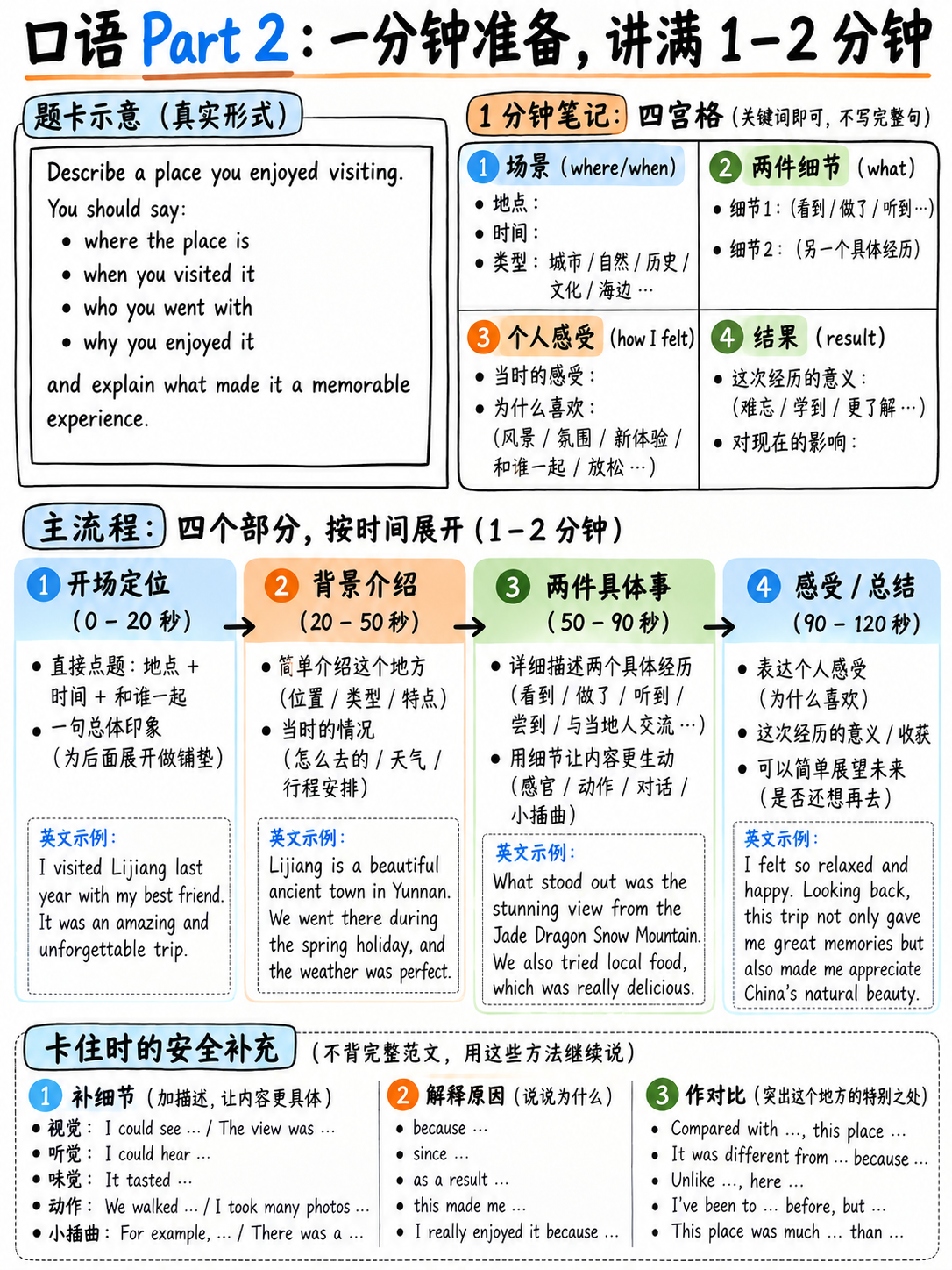
雅思口语 Part 2 官方称为“个人长陈述(Individual Long Turn)”,全程耗时约 3–4 分钟。官方考规规定:“考生会拿到一张题卡(Cue Card),要求就特定话题进行阐述。考生享有 1 分钟的准备时间,并在此期间可以在草稿纸上速记笔记;随后需要进行 长达 2 分钟的不间断个人独立发言。考官随后可能提出一至两个简短的收尾问题” [1]。
Part 2 是绝大多数中国考生最恐惧的“滑铁卢”:面对考官的注视,一个人在空荡荡的房间里持续说满 120 秒,许多人在第 45 秒就讲完所有素材,随后面面相觑陷入长达 15 秒的绝望死寂。
但真相恰恰相反:Part 2 实际上是雅思口语中最容易通过科学结构化套路拿高分的环节! 因为题卡本身已经替你写好了完美的演讲提纲。本章将为你传授 1 分钟草稿纸骨架速记法、四段式故事线架构与 70 秒卡壳急救技术。
20.3.1 官方题卡 (Cue Card) 深度拆解:现成的四段式提纲
考场上考官递给你的是一张塑料卡片、一支铅笔和一张草稿纸。这是官方真实样题题卡 [13] 的标准格式:
   ┌────────────────────────────────────────────────────────────┐
   │                                                            │
   │   Describe something you own which is very important       │
   │   to you.                                                  │
   │                                                            │
   │   You should say:                                          │
   │                                                            │
   │        • where you got it from                             │
   │        • how long you have had it                          │
   │        • what you use it for                               │
   │                                                            │
   │   and explain why it is important to you.                  │
   │                                                            │
   └────────────────────────────────────────────────────────────┘
仔细剖析这张卡片的内在逻辑:
第一句是核心母题:“Describe something you own which is very important to you.”(描述一件对你非常重要的私人物品)。
中间三行导引提示点 (Bullets):从事实维度引导你展开:来自何处、拥有多久、平时用来干什么。
最后一行核心点 (The Explain Line):“and explain why it is important to you”(并详细解释它为何对你如此重要)。
重要
题卡结构就是现成的 120 秒演讲提纲! 题卡上的 3 个子要点加上最后 1 个 “and explain” 核心点,正好构成了整整 4 个自然段落!
Bullet 1(来源与背景):25–30 秒
Bullet 2(持有时间与渊源):25–30 秒
Bullet 3(日常用途与场景):25–30 秒
Explain Line(深层原因与情感价值):35–40 秒(这是考官给分的核心决胜段落!)
4 个板块 × 30 秒 = 120 秒。你根本不需要临场烧脑重新设计故事结构,题卡已经替你划分了节奏!
20.3.2 1 分钟黄金速记笔记法 (Note-taking SOP)
考官说完指令并按下秒表后,你拥有 整整 60 秒。很多考生在这 1 分钟内盲目写完整的英语句子,结果刚写出两行考官就喊停,发言时低头念稿导致完全没有眼神交流,被考官判定为机械背诵。
1. 草稿纸极速排版模板:5 行骨架法
草稿纸上绝对不要写整句,只写“名词 + 数字 + 动词缩写”!如下所示:
   ┌────────────────────────────────────────────────────────────┐
   │                  草稿纸 1 分钟实战速记示范                 │
   │                                                            │
   │  WHAT:  Bicycle (old, 2nd-hand)                            │
   │  1) Where: shop near station, 4 yrs ago, €120              │
   │  2) How long: 4 yrs (repaired twice, tyres changed)        │
   │  3) Use for: commute (25 min), weekend along river (30km)  │
   │  WHY:   1. practical: no car, cheap                        │
   │         2. personal: escape work stress, no phone          │
   └────────────────────────────────────────────────────────────┘
2. 1 分钟准备时间四步执行准则
前 10 秒果断定题,绝不纠结:口语考试不评分内容的真实性。选择你词汇储备最多、最容易展开细节的对象,绝不要选真实但英文表达极其艰涩复杂的事物(例如不要去描述“一把明代紫砂壶”,而应果断选择“一辆旧自行车”或“一部旧手机”)。
中间 40 秒快速填充中间 3 个 Bullets:每行只写 2–3 个核心实词,外加 1–2 个具体的数字或时间点。
最后 10 秒全部押注在 “Why” 核心段:提前在草稿纸上写下两个层面的原因(如:1. 实用价值 Practical;2. 情感心理价值 Emotional),确保讲到最后 40 秒时有源源不断的素材输出。
小技巧
数字与时间戳是考场“零词汇成本”的时间填充神器!
“四年前(Four years ago)”、“大约两小时(Around two hours)”、“一百二十欧元(120 euros)”、“二十五分钟(25 minutes)”、“三十公里(30 kilometres)”……
在发言中密集加入数字和时间参照,不仅无需消耗高难度词汇,还能自然充填数秒时间,更能给考官带来“极其具体、真实、有说服力”的语言精密度(Precision)!
20.3.3 四段式故事线架构与考场配速表
发言时按照以下结构从容推进:
结构模块 |
建议时长 |
核心任务与表达内容 |
官方标准对标句型 (Sentence Frames) |
|---|---|---|---|
Block 0: 开场切题 |
5–10 秒 |
明确点名陈述主题,平稳起步 |
“I’d like to talk about [X], which is probably one of the most…” |
Block 1: 导引点一 |
25 秒 |
交代背景、发生时间、地点与来源 |
“I actually got it about [time] ago from…, when I was…” |
Block 2: 导引点二 |
25 秒 |
阐述持有时长、演变过程与难忘插曲 |
“So I’ve had it for roughly [time] now, and over that period…” |
Block 3: 导引点三 |
25 秒 |
描述日常使用场景、频率与具体生活细节 |
“These days I mainly use it for… In fact, on average I…” |
Block 4: 深度阐述 (Explain Why) |
35–40 秒 |
全篇核心决胜局:从实用与情感两个维度深入剖析价值 |
“As for why it matters so much to me, there are really two main reasons. The first is practical… But on a deeper personal level,…” |
Block 5: 自然收尾 |
5 秒 |
简短总结,优雅停顿 |
“So looking back, that’s essentially why it’s so irreplaceable to me.” |
备注
如果你说到第 2 分钟被考官举手打断,这是极佳的标志!这证明你的语速与内容完美填满了法定时间。考官打断后,请保持微笑,自然进入收尾简答环节。
20.3.4 全真官方高分范文精析 (含意群断句与重音标注)
以下示范基于官方样题题卡 [13] 精心编撰,全文字数约 280 词,语速从容下恰好耗时 1 分 55 秒。
文本中已用符号 │ 标注意群切分边界(Chunking boundaries),加粗部分代表句子重音所在,供初学者体会地道节奏。
I’d like to talk about my bicycle, │ which is probably the thing I’d be most sorry to lose.
I bought it about four years ago, │ from a small second-hand shop │ near the train station in my home town. │ It wasn’t particularly expensive — │ I think it cost around a hundred and twenty euros │ — and honestly it was already quite old │ when I got it. │ The man in the shop told me │ it had been repaired twice, │ which at the time worried me a little.
So I’ve had it for roughly four years now, │ which makes it the longest I’ve ever kept anything like that. │ I’ve replaced the tyres twice │ and the brakes once, │ so in a way │ it’s not really the same bicycle anymore.
I use it mainly for getting to work. │ It takes me about twenty-five minutes, │ which is actually faster than taking the bus │ in the morning rush hour. │ At the weekend │ I sometimes ride out of the city │ along the river, │ maybe covering thirty or forty kilometres │ if the weather’s good.
As for why it matters so much to me — │ there are two reasons, really. │ The first is purely practical: │ I don’t own a car, │ and I’d have to spend a lot more money on transport without it. │ But the second reason is much more personal. │ When I’m cycling │ I stop thinking about work │ completely, │ and that’s become quite important to me │ over the last couple of years, │ because my daily routine has got a lot more stressful. │ It’s basically the only time of day │ when nobody can contact me.
So it’s just a cheap second-hand bike, │ but I’d be genuinely upset │ if it were stolen.
范文高分维度与考官打分点解构
核心提分维度 |
范文对应语句表现 |
官方评分标准对标说明 |
|---|---|---|
流利连贯 (FC) |
严格按照题卡 3 个要点与 Explain 点层层推进;使用 “As for why…”, “So I’ve had it…”, “The first is… But the second…” 衔接词。 |
Band 7 核心指标:“Flexible use of spoken discourse markers, connectives and cohesive features.” |
精确细节支撑 |
密集嵌入 10 处时间与数字锚点:four years ago, 120 euros, repaired twice, 25 minutes, thirty or forty kilometres, two reasons, etc. |
通过数字极大充实了陈述密度,无需背诵生僻名词即可展现具体表达能力。 |
语法多样性 (GRA) |
混合了简单句与高频从句:定语从句(which worried me a little)、现在完成时(I’ve had it, I’ve replaced)、虚拟条件句(I’d be genuinely upset if it were stolen)。 |
Band 6–7 语法基准:“Produces a mix of short and complex sentence forms”,自然展现复合时态。 |
审慎软化用词 (LR) |
恰当融入地道软化词:probably, roughly, honestly, in a way, maybe, genuinely. |
考官官方范文评语盛赞的“高级语言软化特征(Softening features)” |
20.3.5 决胜神技:“两个原因(Two Reasons, really)”万能对比轴线
在第 4 段回答 “Explain why…” 时,最怕无话可说。此时必须立刻触发黄金句型:
“As for why it matters so much to me, there are really two main reasons…”
说出这句话能瞬间带来三大考场战略收益:
争取构思时间:念出这句长达 14 个单词的引子,稳稳为你争取 3 秒的思考缓冲;
强制锁定展开结构:你在口头上承诺了“两个原因”,大脑会立刻自发沿着 1 和 2 展开,强行确保你讲满后半程的 35 秒;
展现高级话语连接结构:属于官方量表重点肯定的连贯性标记。
三大万用对比轴线清单(适用于 99% 的题卡)
对比轴线 |
核心对比逻辑与中英句型框架 |
适用题卡类型 |
|---|---|---|
1. 实用价值 vs 情感价值 |
“Partly it’s purely practical — [实用功能]. But on a deeper level, there’s also a strong emotional connection, because [情感羁绊].” |
物品、技能、手机软件、日常活动、金钱储蓄等 |
2. 过去认知 vs 如今反思 |
“To be honest, back then I only cared about [过去的幼稚想法]. But looking back these days, I realise it taught me [如今的深刻领悟].” |
难忘经历、困难决定、童年回忆、某次迟到、旅行等 |
3. 个人层面 vs 社会他人 |
“For me personally, it was important because [对我的意义]. But I think for my family/others, it was also significant since [对他人的影响].” |
人物、聚餐、帮助他人、庆祝活动、公共地点等 |
20.3.6 70 秒突然讲完素材?“卡壳急救箱”六大延展话术
如果你语速过快,在 70 秒 左右发现题卡上的点全讲完了,考官依然直视着你没有喊停,切记千万不要闭嘴!
立刻从以下 6 种“急救展开法”中抓取一条,强行充实后半程:
急救操作手法 |
考场急救高分接话框架 |
可争取时间 |
|---|---|---|
1. 补充刚才遗漏的一个小插曲 |
“Oh, one minor detail I should probably add is that…” |
15–20 秒 |
2. 现场追加一个极具体的真实微案例 |
“Actually, a classic example of that happened just last month. What happened was…” |
25–30 秒 |
3. 设立假设并对比另一种可能性 |
“I suppose I could have chosen [an alternative] instead, but looking back I’m really glad I didn’t, because…” |
20 秒 |
4. 展望该事物未来的演变与打算 |
“And thinking about the future, in a couple of years’ time I imagine I’ll probably…” |
20 秒 |
5. 引入身旁朋友/亲人的相反态度 |
“It’s quite funny, actually, because my roommate feels completely the opposite way about this. They always say…” |
20–25 秒 |
6. 提出反向限定并自我修正 |
“I wouldn’t go as far as saying it’s the absolute best [X] in the world, but it’s certainly had a huge impact on…” |
15–20 秒 |
20.3.7 考官收尾提问 (Rounding-off Questions) 的应对原则
在说满 2 分钟后,考官叫停并可能顺势提出 1–2 个非常简短的小问题(Rounding-off questions)[1] [13],例如:
“Is it valuable in terms of money?”(它在金钱上值钱吗?)
“Would it be easy to replace?”(它容易被替代吗?)
警告
收尾问题切忌长篇大论! 收尾问题的唯一目的,是作为从 Part 2 独白过渡到 Part 3 深度讨论的平稳桥梁。
原则:只需回答 1 至 2 句话,耗时 5–10 秒即可!
官方示范考生回答
[13]:
“Not really in terms of cash, but emotionally it’s completely irreplaceable because it was a gift from my parents.”
回答完毕后自然停下,等待考官宣布开启 Part 3。
20.3.8 六大核心母题库:用“3 个万能人生故事”破局 80% 题卡
每年雅思口语题库看似有上百道 Part 2 题目,但从深层分类学来看,所有题卡均严格归属于以下六大母题板块:
母题分类 |
题卡高频设问范围 |
核心备考资产准备建议 |
|---|---|---|
A. 人物类 (People) |
钦佩的长辈、有创造力的人、好朋友、优秀的老师、勤奋的人、想结识的名人 |
准备 2 位真实熟人(如:一位严厉而睿智的老师、一位充满热情的创业朋友),储备 8 个性格品质形容词。 |
B. 地点类 (Places) |
放松之地、想去的城市、历史建筑、优美自然风光、常去的餐馆或咖啡馆 |
准备 2 个地点:一个极其熟悉的生活常去处(家附近的河边公园),一个向往的旅行地。 |
C. 物品类 (Objects) |
珍贵之物、手机软件、收到的礼物、一件难用的科技产品、常穿的衣服、老照片 |
准备 2 件物品:一件电子数码产品(手机或旧电脑),一件非电子纪念品。 |
D. 事件经历类 (Experiences) |
难忘的旅程、一次迟到、艰难的决定、开心的时刻、帮助他人、计划被打乱 |
准备 3 个亲身生活故事(详见下文)。 |
E. 习惯活动类 (Activities) |
健康的活动、下班后的放松方式、最近学到的技能、省钱的习惯、户外运动 |
准备 2 个生活习惯(慢跑或下厨)。 |
F. 媒体影视类 (Media) |
喜欢的电影、读过的书、有用的网站/公众号、难忘的新闻、一条有价值的建议 |
准备 1 部电影与 1 本书 的核心剧情梗概与感悟。 |
重要
“万能故事置换法”:高性价比备考核心
在上述所有板块中,精心准备 3 个带有具体时间、地点、波折与反思的人生故事,提分杠杆最高!
例如,准备一个“大雨天赶火车去异地参加竞赛,结果火车晚点,最后在陌生人帮助下涉险过关”的故事:
考到“难忘的旅程”:可以用它;
考到“一次迟到的经历”:可以用它;
考到“他人帮助你的时刻”:可以用它;
考到“计划突然改变的经历”:可以用它;
考到“一次困难的决定”:可以用它;
考到“学到新技能/解决问题的经历”:依然可以用它!
这就是为什么不建议背诵上百篇现成范文。沉淀 3 个属于你自己的真实故事骨架,临场灵活嫁接,才是真正的通关密码!
上一章: 02. Part 1 日常问答破局:回答长度、展开结构与高分答题框架 (Part 1 Tactics) | 下一章学习指南: 04. Part 3 深度讨论与思辨:从个人经验跃升到社会宏观视角的推演公式 (Part 3 Discussion)