05. 流利度引擎:填补停顿、买时间句型与自然衔接技术 (Fluency Engine)
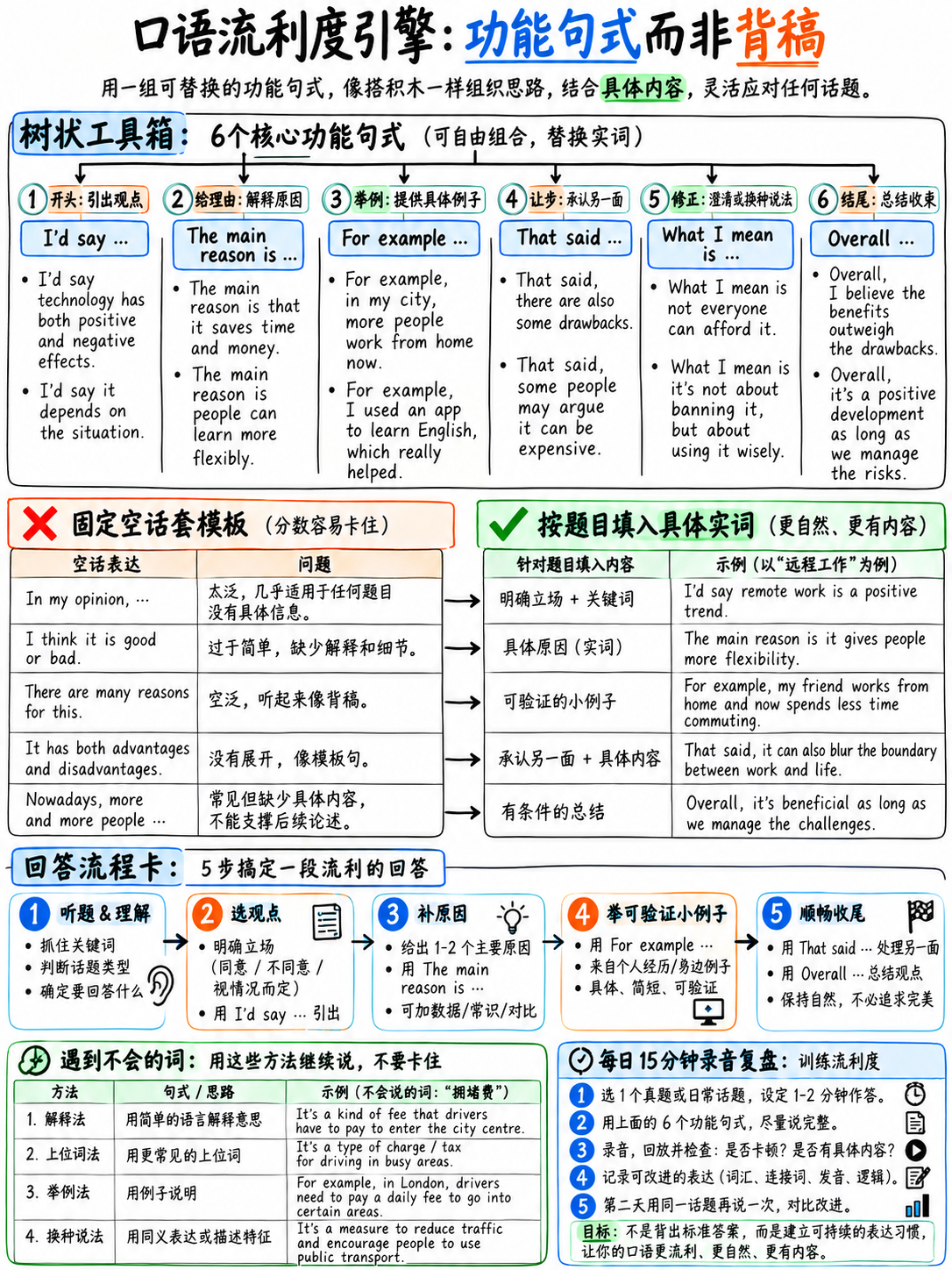
在雅思口语考场上,几乎所有中国考生都曾经历过这样的致命时刻:面对考官的提问,脑海中一片空白;或者明明知道中文意思,对应的英文高级词汇却死活卡在舌尖,全场陷入长达 5 秒令人窒息的死寂。
这种因为“找词、搜语法”而产生的句中长沉默,正是官方评分量表《Speaking Band Descriptors》中明确标示的 Band 5 核心扣分指标(“pausing during which the test taker searches for words”)[11]!
本章将为你装载一套经官方标准检验的流利度引擎(Fluency Engine)——掌握“买时间句型”、分类话语标记库、迂回转述(Paraphrase)技术以及 14 分钟全真考试体能分配策略,让你在考场上无论遇到任何难题都能像母语者一样自然、平稳、无卡壳地持续输出。
20.5.1 底层逻辑:为什么“句型框架”合规加分,而“机械模板”判极低分?
许多考生困惑:一方面网络上到处在卖“万能口语模板”,另一方面官方却三令五申“严惩背诵(Memorised answers)”。这两者之间的界限究竟在哪里?
请看官方评分标准中两条看似矛盾实则分明的硬性指标:
流利度 Band 6 官方标准:
“Uses a range of spoken discourse markers, connectives and cohesive features though not always appropriately.”(能使用一系列口语话语标记、连接词与衔接手段,虽偶有不当)[9]。
流利度 Band 7 官方标准:
“Flexible use of spoken discourse markers, connectives and cohesive features.”(能够灵活、自如地使用口语话语标记、连接词与衔接手段)[9]。
由此可见,官方不仅不反对连接手段,反而在 Band 6 和 Band 7 中白纸黑字地将其列为采分点! 区别在于:
维度对比 |
官方采分的“话语标记与框架 (Discourse Markers)” |
官方严厉打击的“机械背诵模板 (Memorised Templates)” |
|---|---|---|
长度结构 |
极其简短,仅 1 至 4 个单词(如 Having said that, In a way)。 |
冗长刻板,包含一整句甚至一整段完整陈述。 |
承载内容 |
纯功能性语法骨架,不承载任何实际事实,只负责串联逻辑。 |
直接承载虚假事实与论据(如 “In this modern fast-changing world…”)。 |
主题适配 |
适用于任何话题(如讨论音乐、天气、经济均可使用 I tend to think)。 |
无法自然契合考题,出现明显的生搬硬套(Off-topic)。 |
官方档位判定 |
Band 6–7 明确加分项 |
Band 1–3 极低分判定(“Memorised utterances”) |
同时,请牢记官方对连接词的反向严厉警示:
流利度 Band 5 官方标准:
“Overuse of certain discourse markers, connectives and other cohesive features.”(过度重复使用某些特定的连接词与衔接手段)[9]。
危险
数量铁律:每种连接词全场最多使用 1–2 次!
本章提供的所有高分短语,在 14 分钟全场考试中,每一个短语最多只允许出现 1 到 2 次!
如果你在全场自如使用了 6 种不同的话语标记,考官会在量表上勾选 Band 7 的“灵活性 (Flexible use)”;但如果你把同一个 To be honest 连说了 6 遍,考官会立刻认定你词汇枯竭,直接把你打入 Band 5 的“过度使用 (Overuse)”!
20.5.2 核心话语标记宝库:九大功能实战速查
以下精选母语者在日常与学术交际中最高频、最自然的短小话语标记(Discourse Markers),按交际功能分类整理:
1. 启动作答与争取起步思考(为你赢得前 2 秒无痛缓冲)
“Well, …” —— 英语中最自然、毫无造作感的万能开场起手式。
“I suppose I’d say…” —— 用于给出初步思考看法。
“Off the top of my head, …” —— 用于回答没有预先准备的即兴列举题(意为“不假思索地凭第一感觉说”)。
“Yes and no, actually.” —— 当真实情况比较复杂、无法用单纯的好坏判定时使用。
“It depends, really.” —— 必须在后半句立刻紧跟它取决于什么(如 It depends really on what kind of budget you have),切忌只扔下这句空话就停下。
2. 观点表达与态度软化(高分审慎表达)
强硬观点(慎用):“I’m fairly convinced that…” / “There’s no question that…”
中性观点:“In my view,…” / “I’d say that…” / “Personally speaking,…”
高级软化观点(官方 Band 7.5+ 极力赞赏):
“I tend to think that…”(我倾向于认为……)
“It seems to me that…”(在我看来似乎……)
“I’d probably argue that…”(我大概会倾向于主张……)
3. 逻辑归因与原因推进
“mainly because…”(主要在于……)
“which is why…”(正因如此,所以……)
“that’s partly down to the fact that…”(这部分归因于……)
“the primary driver behind this is…”(背后的核心驱动力是……)
4. 具象案例引入
“For instance,…” / “Take [X], for example.”(以……为例)
“In my own experience,…”(就我个人的亲身经历而言……)
“Like last week, when…”(比如上周发生的一件事……)
“I remember reading somewhere that…”(我记得在某个报道里读到过……)
5. 辩证让步与高分转折(决胜 7 分核心标记)
“Having said that, …”(话虽如此;尽管这么说)
“That said, …”(话虽如此,更口语化精炼版)
“On the other hand, …”(另一方面)
“To be fair, though, …”(平心而论;客观公正地讲)
“It’s not that [A], it’s more that [B]…”(并不是因为 A,更多是因为 B……)
6. 信息递进与补充
“On top of that, …”(除此以外;更有甚者)
“What’s more, …”(而且更为关键的是……)
“Not only that, but…”(不仅如此,而且……)
“Another thing worth mentioning is that…”(另一个值得一提的是……)
7. 审慎客观概括(规避绝对化错误)
“Generally speaking, …”(总体而言)
“As a rule, …”(通常情况下;一般说来)
“In the vast majority of cases, …”(在绝大多数情形下)
“People tend to… rather than…”(人们往往会……而非……)
8. 口误修正与换词(展现语言监控力)
“Sorry, what I mean is…”(抱歉,我的实际意思是……)
“Or rather, …”(更准确地说是……)
“Let me put it another way: …”(让我换一种更恰当的说法……)
备注
官方量表 Band 7 明确允许句中自然的自我修正(“Self-correction often mid-sentence”)[9]。考场上偶然说错一个单复数或发音,使用 “or rather” 自然改口,绝不扣分,反而是自信语言监控能力的体现!
9. 话轮自然收尾
“So yes, that’s basically my take on it.”(所以,这基本上就是我对它的看法。)
“Anyway, that’s why it stands out so much to me.”(不管怎么说,这就是它为何对我如此独特的缘由。)
20.5.3 考场“买时间 (Time-Buying)”段位金字塔
当考官抛出一个出乎意料的难题,你需要 3 至 5 秒组织语言时,你的应对策略直接决定了你的分数层级:
   ┌────────────────────────────────────────────────────────────────────────┐
   │                       考场“买时间”段位金字塔                           │
   │                                                                        │
   │  王者级 (Diamond Tier) —— 借题发挥,复述题干转化为陈述句               │
   │  • 考官: "Why do people care about social status?"                     │
   │  • 考生: "Why people care so much about status... I think that comes   │
   │           down to two quite distinct things."                          │
   │  ★ 耗时 4 秒,展现 100% 听力理解与从容气度,零多余词汇成本!           │
   │                                                                        │
   │  大师级 (Gold Tier) —— 软化评价 + 主动缩小问题范围                    │
   │  • 考生: "That's quite a broad question to tackle, actually. I suppose │
   │           I can really only speak about my own country..."             │
   │  ★ 耗时 5 秒,展现高阶学术严谨性,同时将题目降维到熟悉领域!          │
   │                                                                        │
   │  熟手级 (Silver Tier) —— 指明回答结构架构                              │
   │  • 考生: "There are probably two main perspectives on this..."         │
   │  ★ 耗时 3 秒,既争取了构思时间,又强行锁定了双向展开结构!            │
   │                                                                        │
   │  青铜级 (Bronze Tier) —— 运用简短自然话语标记                          │
   │  • 考生: "Well... let me think for a second."                          │
   │  ★ 耗时 2 秒,安全合规,但每场考试限用 1 次。                         │
   │ ────────────────────────────────────────────────────────────────────── │
   │  地狱级 (Toxic Tier) —— 致命失分扣分区 (千万杜绝)                     │
   │  ❌ 满嘴无意识无意义的低级喘息与叹声: "Er... ah... um... er..."         │
   │  ❌ 脑中痛苦搜词导致全场长达 5 秒的绝对死寂 (直接锁死 Band 5 FC)!      │
   │  ❌ 呆若木鸡只蹦出一句: "I don't know." 并彻底停滞!                   │
   └────────────────────────────────────────────────────────────────────────┘
警告
坚决用“填充词组 (Filler Words)”替代“填充声音 (Filler Sounds)”!
母语者在思考时也会停顿,但他们使用的是语义饱满的话语标记(如 I suppose, in a way, you see)。
如果你的作答被连续的 “Er… um… ah…” 填满,考官会根据量表直接标记为 Band 5 典型的“因检索基础词汇与语法而出现的无功能停顿” [9] [11]!
20.5.4 同义迂回转述 (Paraphrase) 集训:跨入词汇 6 分大门
官方标准中,词汇 5 分与 6 分的生死线几乎全部由这一条定义:
Band 5 LR:“Attempts paraphrase but not always with success.”(尝试迂回转述,但屡屡失败导致沟通断层)
[9]。
Band 6 LR:“Generally able to paraphrase successfully.”(大体能够成功实现迂回转述与解释)[9]。
转述能力是一项可以被彻底刻意训练的实战技能,而不是玄学!
迂回转述三大万能公式
转述公式 |
逻辑结构定义 |
实操范例:你不会说“听诊器 (stethoscope)” |
|---|---|---|
1. 功能描述法 (Function) |
“It’s a thing/device you use to [动词动作]…” |
“It’s a tool that doctors use to listen to your heartbeat or chest.” |
2. 类别 + 特征法 (Category + Feature) |
“It’s a kind of [上位词概念], with [物理特征]…” |
“It’s a kind of medical instrument with two earpieces and a metal disc.” |
3. 熟悉客体类比法 (Comparison) |
“It’s quite similar to a [常见物], except that…” |
“It’s like a special pair of headphones, but designed for physicians.” |
考场免死金句
当你遇到生词卡壳时,立刻自然说出:
“I can’t recall the precise English term for this, but it’s basically a kind of [使用上述公式描述]…”
说出这句话,考官绝不仅不会扣你的词汇分,反而会在打分纸上欣慰地为你勾选 Band 6–7 的官方转述能力加分项!
30 个考场高频实物与概念迂回转述挑战表
练习要求:看到下列中文词汇,假定你不会该单词,强迫自己在 8 秒钟内 用英语口头描述出其核心特征:
序号 |
目标概念 |
真实单词 |
万能迂回描述示范 (Paraphrase Model) |
|---|---|---|---|
1 |
热水壶 |
a kettle |
“an electrical kitchen appliance used for boiling water quickly” |
2 |
订书机 |
a stapler |
“a small office tool used to pin paper sheets together with metal clips” |
3 |
疫苗 |
a vaccine |
“a medical injection that protects people from catching severe diseases” |
4 |
垃圾分类回收 |
recycling |
“the process of treating used plastic, glass or paper so they can be reused” |
5 |
交通堵塞 |
a traffic jam |
“a situation where vehicles are stuck on the road and barely moving” |
6 |
郊区 |
a suburb |
“a residential district located on the outer edge of a big city” |
7 |
温室大棚 |
a greenhouse |
“a glass building where delicate plants and vegetables are kept warm” |
8 |
自动售货机 |
a vending machine |
“a coin-operated machine on the street that dispenses drinks and snacks” |
9 |
房贷 |
a mortgage |
“a large long-term bank loan specifically used for purchasing a property” |
10 |
截止日期 |
a deadline |
“the final date or time by which a project or essay must be finished” |
11 |
房东 |
a landlord |
“the owner of a house or flat that other people pay rent to live in” |
12 |
奖学金 |
a scholarship |
“financial aid granted to students by universities based on high grades” |
13 |
加班 |
overtime |
“extra hours that an employee works beyond their standard contractual time” |
14 |
个人简历 |
a CV / résumé |
“a formal document detailing a person’s education, work history and skills” |
15 |
养老金 |
a pension |
“a regular income paid by the state or company to people who have retired” |
16 |
实习经历 |
an internship |
“a temporary job taken by students to gain hands-on professional experience” |
17 |
财政预算 |
a budget |
“a detailed financial plan estimating income and planned expenditures” |
18 |
通货膨胀 |
inflation |
“the general rise in prices over time, which reduces the value of money” |
19 |
每日通勤 |
a commute |
“the regular journey that someone makes between home and their workplace” |
20 |
退款 |
a refund |
“money returned to a customer when they return unsatisfactory goods” |
21 |
排队 |
a queue |
“a line of people waiting patiently for their turn to buy or enter something” |
22 |
发票收据 |
a receipt |
“a printed slip of paper confirming that you have paid for a purchase” |
23 |
房屋押金 |
a deposit |
“a sum of money paid in advance to secure a rented flat against damage” |
24 |
租房合同 |
a lease |
“a legal contract signed between a tenant and a landlord setting rental rules” |
25 |
大学辅导课 |
a tutorial |
“a small-group discussion class led by a university tutor” |
26 |
毕业论文 |
a dissertation |
“a long piece of academic research written for a university degree” |
27 |
销售提成 |
a commission |
“an extra fee paid to an agent based on the percentage of sales achieved” |
28 |
政府补贴 |
a subsidy |
“money given by public authorities to keep the price of essentials low” |
29 |
智能吸尘器 |
a robot vacuum |
“an automated electronic cleaning gadget that sweeps floors by itself” |
30 |
随行背包 |
a rucksack / backpack |
“a large sturdy bag carried on your back, ideal for hiking and travelling” |
20.5.5 考场“听不懂或没听清考官提问”时的官方应对 SOP
考场中因为考官口音、连读弱读或考室杂音导致没有完全捕捉到问题,是极其普遍的人际现象。官方真实考场录音中,高分考生也会自然向考官确认提问 [13]。
遇到听力障碍,按以下四类场景得体应对:
   ┌────────────────────────────────────────────────────────────────────────┐
   │                       考场听音障碍应对四锦囊                           │
   ├───────────────────────────────┬────────────────────────────────────────┤
   │ 场景 1: 完全没听清声音        │ "Sorry, could you repeat that please?" │
   │                               │ (完全合规,零扣分)                     │
   ├───────────────────────────────┼────────────────────────────────────────┤
   │ 场景 2: 某个具体单词不懂      │ "Sorry, what does the word [X] mean?"  │
   │                               │ (仅限 Part 1 和 3,考官有义务做同义释义│
   │                               │  千万不要不懂装懂盲目答非所问)         │
   ├───────────────────────────────┼────────────────────────────────────────┤
   │ 场景 3: 单词都听懂但题意抽象  │ "Do you mean [你的理解], or are you    │
   │                               │  referring to [另一层含义]?"           │
   │                               │ (展现主动求证与学术思辨互动)           │
   ├───────────────────────────────┼────────────────────────────────────────┤
   │ 场景 4: 题意听懂但极其生僻偏门│ "To be honest, it's not something I've │
   │                               │  considered before, but I'd guess..."  │
   │                               │ (坦白思考状态,随后给出假设推演)       │
   └───────────────────────────────┴────────────────────────────────────────┘
20.5.6 14 分钟全真考试体能与节奏管控 SOP
雅思口语是一场高强度的脑力与心理消耗战。许多考生在最后两分钟因为精力耗尽,语音语调完全塌陷,导致前功尽弃。
严格按照以下时间轴管控你的考场表现:
时间节点 |
考场环节 |
考生关键动作与体能纪律 |
|---|---|---|
0:00 – 0:30 |
考场破冰与证件核对 |
抬头挺胸,保持微笑与眼神接触。用洪亮清晰的声音回答 “Good morning” 与递交证件,给考官留下自信发音第一印象。 |
0:30 – 5:00 |
Part 1 日常问答 (8–12题) |
严格执行“两句话原则(Answer + Extend)”。每题控制在 15–20 秒,切忌单词作答,切忌喧宾夺主过长演讲。 |
5:00 – 6:00 |
Part 2 题卡草稿准备 |
抓起铅笔,在草稿纸上画出 5 行骨架;只记名词与数字;最后 10 秒死磕 Why 段落的“实用 vs 情感”两点原因。 |
6:00 – 8:00 |
Part 2 个人长独白 |
紧盯草稿纸上的数字与时间轴;讲满整整 2 分钟直到考官叫停。若 70 秒素材讲完,立刻触发“急救箱话术”延展。 |
8:00 – 8:30 |
Part 2 收尾简短过渡题 |
极简回答,1–2 句话结束(5–10秒),优雅过渡,深吸一口气调整状态。 |
8:30 – 13:00 |
Part 3 宏观深度讨论 (5–7题) |
全面进入 AREQ 宏观推演模式!每题输出 3–5 句话(30–45秒);运用人群拆分与利益权衡降维打击难题。 |
13:00 – 14:00 |
尾声与全场结束 |
绝对警惕体力崩塌!考官打分依托“全场平均综合水平(Average across all parts)” |
20.5.7 每日 15 分钟口语晨读与刻意训练清单
不需要每天花两个小时毫无目的地背题库。按照以下高度结构化的 SOP 每天刻意练习 15 分钟,四周内将建立强大的肌肉记忆:
第 1–3 分钟(发音与意群断句):选取第 03 篇中的高分范文一段,大声朗读,严格遵循标注的意群线
│进行停顿,强化句子重音与弱读。第 4–6 分钟(转述挑战):随机从 §20.5.4 中抽取 5 个生词,强迫自己在 10 秒内用英语功能法或类比法将其描述出来。
第 7–9 分钟(Part 1 极速反应):随机挑选 4 道 Part 1 问题,打开手机录音机,以“Answer + Extend”两句话模式作答,每题计时 20 秒。
第 10–12 分钟(Part 2 结构独白):挑选 1 张题卡,用 1 分钟草稿纸速记 5 行骨架,随后独立计时说满 2 分钟。
第 13–15 分钟(复盘诊断):回听 Part 2 录音,对照评分标准在错误笔记本(Error Log)中记录一条具体问题(如:时态不准、停顿过长或平调),次日专项突破!
上一章: 04. Part 3 深度讨论与思辨:从个人经验跃升到社会宏观视角的推演公式 (Part 3 Discussion) | 下一章学习指南: 06. 口语高频题库全真演练与高分答题示范 (Speaking Practice Bank)