02. Part 1 日常问答破局:回答长度、展开结构与高分答题框架 (Part 1 Tactics)
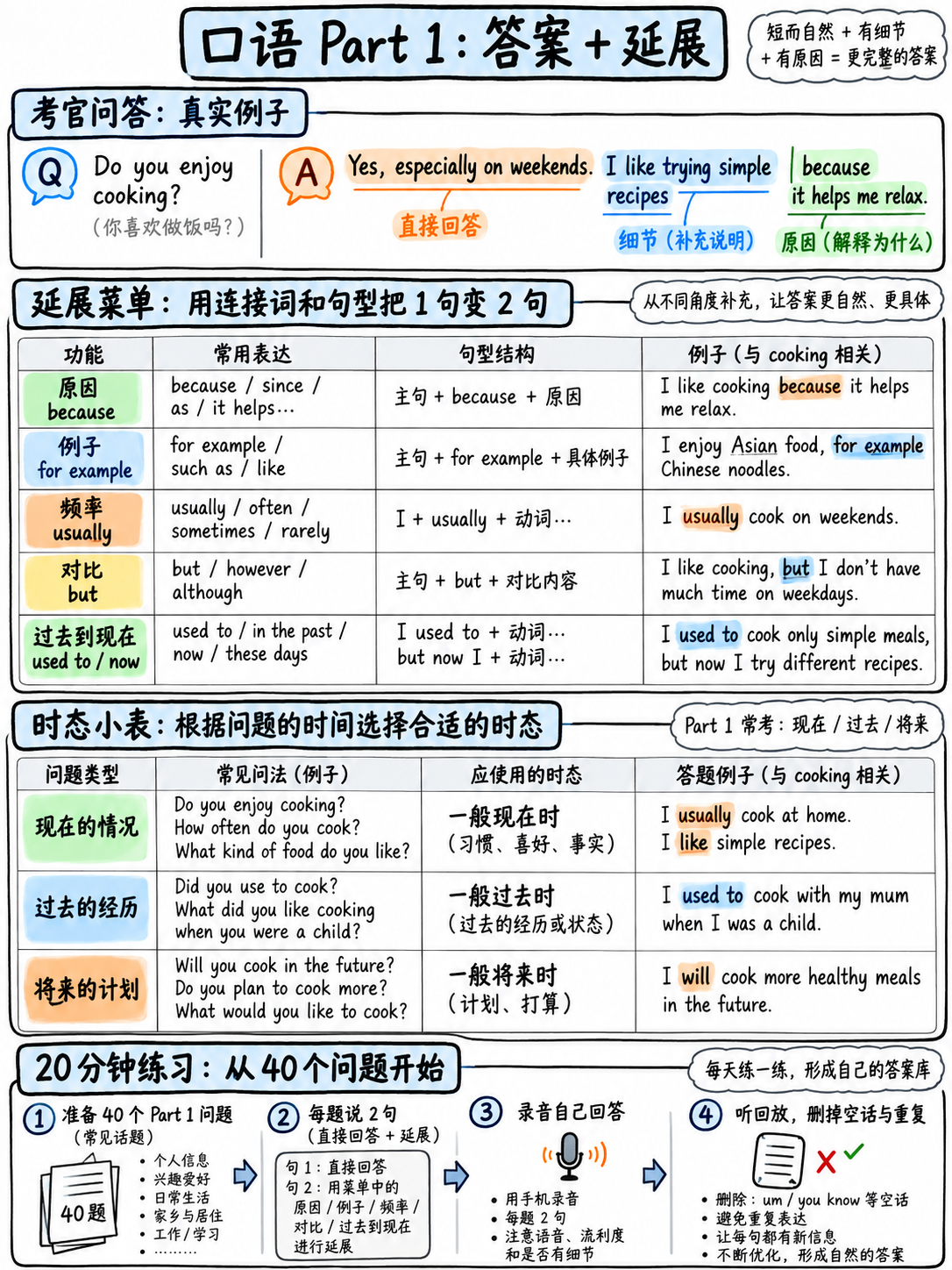
雅思口语 Part 1 官方定义为“日常问答与自我简介(Introduction and Interview)”,耗时 4–5 分钟。官方大纲规定:“考官就考生的日常生活、背景及一系列熟悉的话题(如家庭、工作、学习、兴趣等)进行简短提问” [1]。
Part 1 是全场考试最轻松、话题最贴近生活的环节,但也是初学者最容易陷入两极分化误区的重灾区:要么像挤牙膏一样只蹦两三个单词(导致考官无法评分判定为 Band 4),要么把它当成大演讲滔滔不绝抢话导致考官强制打断。本章将为你拆解 Part 1 的最佳回答长度、万能展开结构与高频必考核心题库。
20.2.1 Part 1 真实考场全流程与节奏控制
在真实考场中,Part 1 的节奏非常紧凑且标准化。官方口语样题录音 [13] 展示了标准进行规程:
   ┌───────────────────────────────────────────────────────────────────────┐
   │                       Part 1 考场全流程三步曲                          │
   │                                                                       │
   │  第 1 步:身份核对 (30秒)                                             │
   │  • 考官打招呼 + 核对身份证件 ("Can I see your ID, please?")           │
   │  • 考生自然回应并递交证件,建立平稳的第一语音印象                    │
   │                                                                       │
   │  第 2 步:必考核心母题 (1–2分钟,3–4个问题)                           │
   │  • 考官切入三门神之一:工作/学业 (Work/Study)、住所 (Home) 或家乡 (Hometown)│
   │                                                                       │
   │  第 3 步:轮换日常话题 (2–3分钟,共 1–2 个话题,每个 3–4 题)          │
   │  • 转向具体生活细节:如音乐、烹饪、天气、手机应用、空闲爱好等         │
   └───────────────────────────────────────────────────────────────────────┘
1. 考场真实问答配速法则
在 4–5 分钟内,考官需要完成 8–12 道简短问答。
这意味着平均每道题的完整交互时间仅为 20–30 秒(包括考官念出题干)。
考生作答黄金时长:15–25 秒(即自然语速下的 2 至 3 句话)。
严禁只答一个词:考官问 “Do you work or are you a student?”,如果你只答 “Student.”,考官无从判断你的连贯性与语法,直接锁死 Band 4–5。
切忌长篇大论演讲:如果一个日常问题你说满 1 分钟,考官会直接礼貌举手打断以完成规定题量。
2. 官方题库“永恒核心金三角”
重要
全球雅思考官的题库中,Topic 1 永远抽选自以下四项之一:Work(工作)、Study(学业)、Home/Accommodation(住所)、Hometown(家乡) [13] [22]。
无论每季度的换题季(1月、5月、9月)如何风云变幻,这三大核心板块永远保持稳定!
这意味着:你可以在考前为你个人的工作背景、学业动机、租住公寓特色、家乡地理特征准备 100% 真实的事实性语料! 这两分钟的开场完全在你的掌控之中。
20.2.2 核心答题逻辑公式:Answer + Extend (AREC 轻量剪裁)
Part 1 答题的核心公式极为纯粹高效:直接作答(Direct Answer)+ 展开支撑(Extend)。
   ┌──────────────────────────────────────────────────────────────────────┐
   │                   Part 1 万能两段式答题框架                          │
   ├───────────────────────────────┬──────────────────────────────────────┤
   │ 1. Direct Answer (直接回答)   │ 用 1 句精炼主句直奔主题,直接回应题干│
   ├───────────────────────────────┼──────────────────────────────────────┤
   │ 2. Extension (展开维度)       │ 叠加 1–2 句支撑细节,从以下 6 条路径 │
   │                               │ 任意任选 1 种进行延展                │
   └───────────────────────────────┴──────────────────────────────────────┘
这个框架正是大作文与 Part 3 的 AREC 论证公式(Answer + Reason + Example + Consequence) 在日常口语中的轻量化剪裁版本:Answer(正面回应)+ Reason/Example/Contrast(原因/案例/转折)。
全真对比示范:低分回答 vs 高分拆解
案例 1:关于家乡 (Hometown)
考官提问: “What kind of place is your hometown?”(你的家乡是个怎样的地方?)
作答版本 |
考生回答文本 |
考官评分心理与逻辑透析 |
|---|---|---|
❌ 低分蹦字版 (Band 4) |
“It’s a big city in China.” |
仅有一句话,信息量极度匮乏。考官无法提取复杂的语法或词汇样本,直接判定流利度不达标。 |
✅ 官方示范版 (Band 6.5–7) |
“It’s quite a large industrial city in the north of the country, with around two million people. It’s not particularly scenic, to be honest, but it’s a very convenient place to live because public transport is so cheap.” |
【Answer】 定位家乡性质与规模(工业城市、两百万人口) |
案例 2:关于日常偏好 (Preference)
考官提问: “Do you prefer tea or coffee?”(你更喜欢茶还是咖啡?)
作答版本 |
考生回答文本 |
考官评分心理与逻辑透析 |
|---|---|---|
❌ 极简版 (Band 4.5) |
“Coffee. Because it is good.” |
句式幼态单薄,思维断层。 |
✅ 官方示范版 (Band 6.5–7) |
“Coffee, definitely. I usually drink two or three cups a day, especially in the morning, mainly because I find it really hard to focus without some caffeine.” |
【Answer】 果断表明喜好态度(Coffee, definitely.) |
案例 3:关于居住时长 (Duration)
考官提问: “How long have you lived in your current apartment?”(你在现在的住处住了多久?)
作答版本 |
考生回答文本 |
考官评分心理与逻辑透析 |
|---|---|---|
❌ 中式语病版 (Band 5) |
“I live here five years.” |
犯下典型中式时态硬伤!直接丢掉 GRA 6 分。 |
✅ 官方示范版 (Band 6.5–7) |
“About five years now. I originally moved there for university and just stayed on, although I’m actually thinking of relocating sometime next year.” |
【Answer】 精准现在完成时含义(About five years now.) |
20.2.4 Part 1 核心语法红线:时态掌控力 (Tense Control)
在 Part 1 中,考官有意识地通过不同的问句形式测试考生的时态敏锐度(Tense Sensitivity)。如果考官用过去时提问而你用现在时回答,考官会立刻在语法记录中标记“基础时态失控”。
以下是 Part 1 必考八大问法与时态对标表:
考官提问句型 |
锁定法定语法时态 |
标杆回答框架示范 |
|---|---|---|
“What do you do?” |
一般现在时 (Present Simple) |
“I work as a software engineer at a tech firm.” |
“What are you studying?” |
现在进行时 (Present Continuous) |
"I*'m currently studying** finance at university."* |
“How long have you lived there?” |
现在完成时 + for/since |
"I*'ve lived** there for around four years."* |
“Did you enjoy your primary school?” |
一般过去时 (Past Simple) |
“I did, absolutely. I had some fantastic teachers back then.” |
“Have you ever travelled abroad?” |
现在完成时 |
"Yes, I*'ve visited** Thailand once, back in 2019."* |
“Would you like to change your job?” |
虚拟与条件语气 (would + 动词原形) |
"I*'d love to**, if the right opportunity came along."* |
“What will you do after graduating?” |
将来时态 (be going to / will / planning to) |
"I*'m planning to** apply for a master’s programme in the UK."* |
“What did you use to do as a child?” |
used to + 动词原形 |
“I used to spend hours drawing cartoons every weekend.” |
警告
中国考生失分率最高的经典语法雷区
被问及 “How long have you lived here?” 时,千万不要说:
❌ “I live here five years.”(完全错误)
正确表达必须牢牢锁定:
✅ “I’ve lived here for five years.” 或 “I’ve been living here for about five years.”
考前请反复强化训练这一句型,其在实战考场中的出场率高达 70%!
20.2.5 遭遇大脑空白时的“六大救命应对锦囊”
口试现场常会遇到生僻偏门的话题(如考官突然问及机器人、收据、养花、镜子等),很多考生瞬间大脑一片空白。
记住原则:考官考查的是英语沟通能力,绝不是你的生活经验! 面对盲区,绝对不要沉默,更不要只说一句 “I don’t know”。
使用以下六大救急框架,将“无话可说”瞬间转化为“高分语言样本”:
考场突发状况 |
救命高分应答应答话术 |
评分效果与机制剖析 |
|---|---|---|
完全没有任何观点 |
“To be honest, I’ve never really thought about that before. I suppose if I had to choose, I’d say [X], mainly because…” |
展现真实口语思考状态,运用假设语气(if I had to…)展现高级语法。 |
完全没有任何经历 |
“I haven’t actually experienced that myself, but a close friend of mine did, and they told me that…” |
巧妙借用他人经历延续话题,规避自身经历空白。 |
对该话题毫无兴趣 |
“It’s not really something I’m keen on, to be honest — I’m much more interested in [Y], because…” |
礼貌坦白个人偏好,并自然切换至熟悉领域。 |
没听清考官提问 |
“Sorry, would you mind repeating the question, please?” |
得体礼貌,合规请求重复,不扣分。 |
听清单词但不确定意思 |
“Sorry, do you mean [X], or are you referring to [Y]?” |
展现主动求证的学术互动能力。 |
某个专业单词不会说 |
“I can’t remember the exact English word for it, but it’s basically a kind of [description]…” |
直接触发词汇转述(Paraphrase)加分项! |
20.2.6 Part 1 全真 40 题分类演练库
建议在考前用手机录音功能,针对以下 40 题进行计时全真演练。每道题强迫自己说出 2–3 句话(15–25 秒),听回放检查是否符合“Answer + Extend”结构。
模块一:核心必考三大主题 (Work/Study, Home, Hometown)
Do you work or are you a student?
What do you study? / What is your current job?
Why did you choose that subject / career?
What do you find most interesting about your studies or work?
Is there anything you would like to change about your job or course?
What are your future career plans over the next few years?
Could you describe the type of home you currently live in?
How long have you been living in your current accommodation?
What is your favourite room in your home, and why?
Do you prefer living in an apartment or a standalone house?
Would you like to move to a different home in the near future?
What kind of place is your hometown?
What is the most interesting or famous attraction in your hometown?
Has your hometown changed significantly since you were a child?
Would you recommend your hometown as a good place for young people to live?
模块二:日常习惯与休闲偏好 (Routine & Leisure)
What do you usually like to do during your weekends?
Do you prefer spending your free time alone or hanging out with others?
Have your personal hobbies changed much over the past few years?
Is there a new activity or skill you would like to take up in the future?
What kind of food do you enjoy eating the most?
Do you prefer cooking meals at home or dining out at restaurants?
Has your diet or eating habits changed recently?
What time do you usually wake up on weekdays?
Would you describe yourself as a morning person or a night owl?
How do you typically unwind and de-stress after a busy day?
模块三:现代生活与数字科技 (Technology & Society)
How much time do you spend using your smartphone each day?
What mobile apps do you find yourself using most frequently?
Do you ever feel that people spend too much time looking at screens?
How did you first learn how to use a computer?
Do you prefer shopping online or visiting brick-and-mortar stores?
Do you enjoy travelling to new destinations?
What has been the most memorable place you have visited so far?
What is the weather typically like where you live during this season?
Which season of the year is your favourite, and why?
How do you usually commute to school or work?
模块四:社交与周边环境 (Social & Surroundings)
Do you know many of your neighbours well?
Do you think it is important to maintain good relationships with neighbours?
What kind of music do you usually listen to?
Do you prefer listening to recorded music or attending live concerts?
Did you learn to play any musical instruments when you were younger?
上一章: 01. 雅思口语评分标准深度拆解:四大维度与考官打分量表 (How Speaking is Scored) | 下一章学习指南: 03. Part 2 个人长陈述:1分钟速记笔记法与2分钟故事线架构 (Part 2 Long Turn)