04. Part 3 深度讨论与思辨:从个人经验跃升到社会宏观视角的推演公式 (Part 3 Discussion)
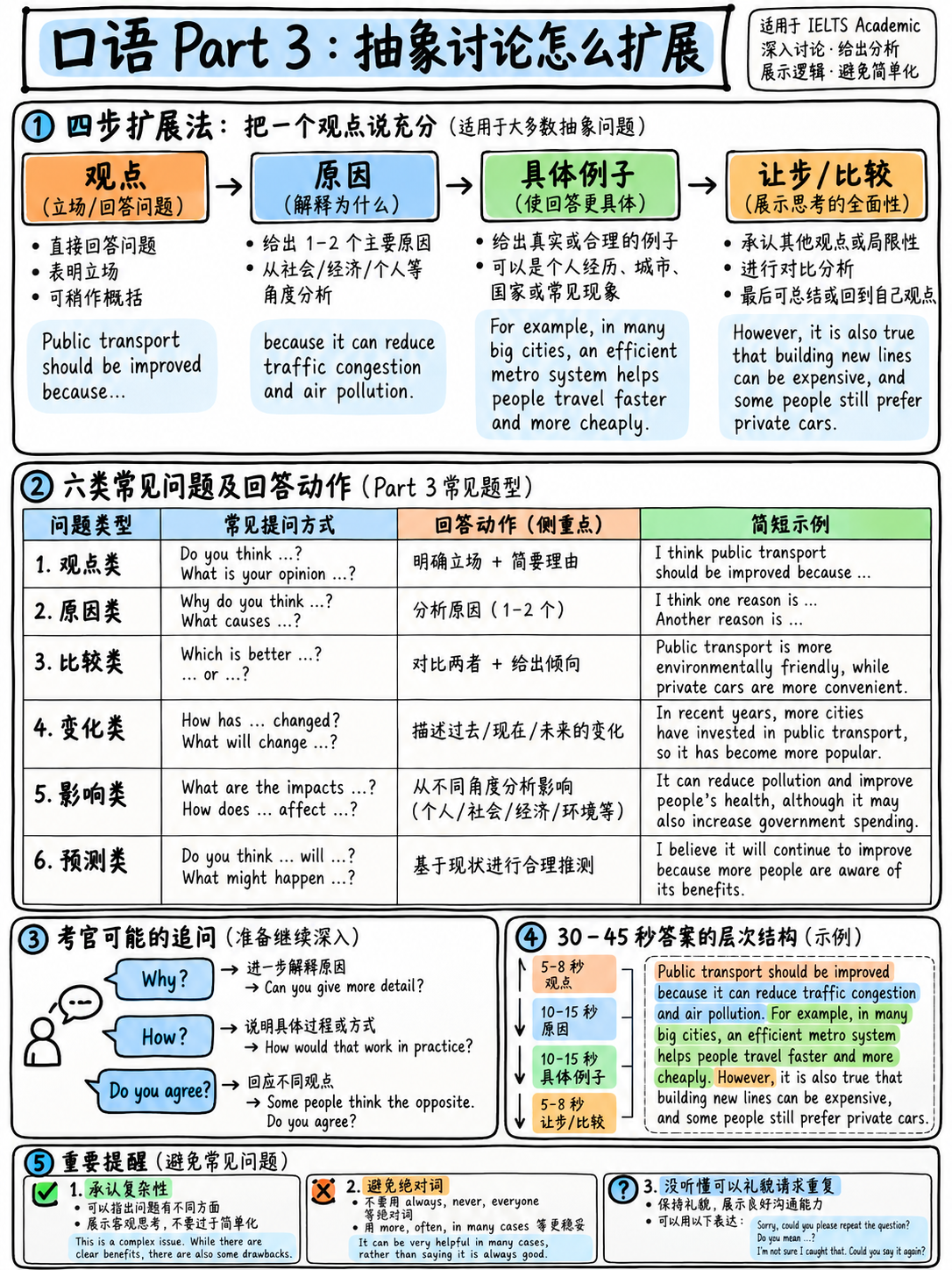
雅思口语 Part 3 官方定义为“双向深度讨论(Two-way Discussion)”,持续时间为 4–5 分钟。官方大纲规定:“考官会提出一系列与 Part 2 话题密切相关的纵深问题。这些问题旨在为考生提供一个**探讨更为抽象的社会议题、观点与概念(Abstract issues and ideas)**的舞台” [1]。
如果说 Part 1 检验日常交流基本功,Part 2 检验独立独白组织力,那么 Part 3 就是真正决定你拿到 6.0 还是突破 7.0+ 的决胜分水岭!
许多考生在进入 Part 3 后频繁陷入中式思维陷阱:考官问及社会宏观问题,考生张口闭口依然是“我妈妈、我朋友、我上个月”,无法脱离个人琐碎经验。本章将为你传授从私人视角飞跃至社会宏观维度的推演公式、六大提问类型破解战术以及三大考场降维解题神技。
20.4.1 Part 3 考场实战机制:考官的攻防节奏
Part 3 不是机械问答,而是一场渐进式的学术探讨(Two-way Discussion)。官方真实样题录音 [13] 显示,考官在 Part 3 呈现出三大鲜明特征:
   ┌────────────────────────────────────────────────────────────────────────┐
   │                       Part 3 考官提问的递进逻辑                        │
   │                                                                        │
   │  第 1 阶:宏观定性 (Descriptive / Causal)                              │
   │  "First, let's consider values. In your country, what kinds of         │
   │   possessions give status to people?"                                  │
   │                                                                        │
   │  第 2 阶:顺藤摸瓜与追问 (Follow-up / Comparative)                     │
   │  "Is that a new development, or have people thought like that for      │
   │   a long time?"                                                        │
   │                                                                        │
   │  第 3 阶:观点挑战与价值评估 (Challenge / Evaluative)                  │
   │  "You don't think of it as a healthy way of thinking?"                 │
   │                                                                        │
   │  第 4 阶:未来推演与政策探讨 (Speculative / Policy)                    │
   │  "And do you think this will change in the future? What should         │
   │   governments do about it?"                                            │
   └────────────────────────────────────────────────────────────────────────┘
1. 考官提问越来越短,挑战性越来越高
考官的初始问题往往较完整,随后会根据你的即兴回答现场追问:“Can you tell me a little bit more about that?” 或 *“Why do you think that happens?”*甚至直接抛出反问挑战。这并不代表考官在为难你,恰恰是因为你的上一句回答展现了高阶语言潜能,考官在主动为你创造冲刺 7 分的契机!
2. 回答配速标准
建议时长:每道题 30–45 秒(即自然语速下的 3 至 5 句话)。
全场 4–5 分钟内,考官通常会推进 5–7 轮深度互动。
过短后果:只说一两句就戛然而止,考官会判定你缺乏“深入展开论述的能力(Willingness to produce long turns)”,止步 5.5 分。
过长后果:一人独白超过 1 分钟会破坏双向互动的属性,考官必将打断。
20.4.2 宏观跃迁:从“个人微观”飞跃至“社会宏观”
中国初学者在 Part 3 最致命的失误是视界过窄。对比以下两段对同一问题的回应:
考官提问: “Why do people care so much about social status?”(人们为什么如此在意社会地位?)
❌ 微观低分回答 (Band 5):
“Because like my classmate, he bought a new iPhone last week, and he showed it to everyone. I think people want to show they have money.”
(剖析:局限于个人同学的琐碎事件,缺乏抽象概括词汇,思维扁平。)✅ 宏观高分回答 (Band 7):
“I think there are two main driving forces here — one psychological and one social. On a personal level, material status often brings a sense of security and validation. But socially, we live in a consumer-driven culture where people are frequently judged by outward appearances rather than character. Having said that, I think younger generations are gradually shifting towards valuing personal experiences rather than pure possessions.”
(剖析:站在心理机制与消费主义社会的宏观高度,词汇涵盖 validation, consumer-driven culture, outward appearances,并以 having said that 做出精妙辩证让步。)
20.4.3 核心推演公式:AREQ / PREQ 宏观辩证架构
为了在 30–45 秒内输出结构严谨、逻辑层层递进的学术级回答,初学者应全面掌握 AREQ 四段推演公式:
   ┌───────────────────────────────────────────────────────────────────────┐
   │                    Part 3 宏观思辨 AREQ 答题公式                      │
   ├───────────────┬───────────────────────────┬───────────────────────────┤
   │ P / A: 观点   │ Position / Answer (1 句)  │ 一针见血直接亮明核心观点  │
   ├───────────────┼───────────────────────────┼───────────────────────────┤
   │ R: 归因       │ Reason (1 句)             │ 挖掘深层社会/经济/心理根源│
   ├───────────────┼───────────────────────────┼───────────────────────────┤
   │ E: 现象       │ Example / Evidence (1–2句)│ 给出广泛社会现象或行业常态│
   ├───────────────┼───────────────────────────┼───────────────────────────┤
   │ Q: 辩证       │ Qualify / Concession (1句)│ **高分胜负手**:审慎让步、│
   │               │                           │ 区分群体或指出未来变数    │
   └───────────────┴───────────────────────────┴───────────────────────────┘
AREQ 实战范文剖析
考官提问: “What kind of possessions give people status in your country?”(在你的国家,什么样的财产会带给人物质地位?)
【Position - 明确观点】
“I’d say luxury cars and prime real estate are still the most prominent status symbols, especially for the older generation.”
(中文精义:我认为豪车和黄金地段的房产依然是最显著的地位象征,尤其是对老一辈人而言。)【Reason - 社会归因】
“Partly that’s because these are highly visible assets — everyone in the street can immediately recognize what you drive, which isn’t the case with someone’s personal savings or investments.”
(中文精义:部分原因在于这些是极具辨识度的显性资产——街上的每个人都能一眼看出你开什么车,而个人储蓄或金融投资则无法做到这一点。)【Example - 宏观现象】
“For instance, in many major cities, it’s quite common to see people parking high-end SUVs in front of modest homes, simply to project an image of financial success to their neighbours.”
(中文精义:例如在许多大城市,人们经常能看到在普通住宅楼前停放着高档SUV,其目的纯粹是为了向邻居彰显经济成功。)【Qualify - 辩证让步(决胜 7 分)】
“Having said that, this perception is definitely evolving among younger demographics. Many young professionals now prioritise international travel or digital nomadism over physical assets, which represents a fundamental shift in values.”
(中文精义:话虽如此,这种观念在年轻群体中正在发生深刻转变。许多年轻白领如今更看重跨国旅行或数字游民生活方式,而非死守固定资产,这体现了价值观的根本重塑。)
小技巧
为什么 Qualify(审慎让步)是 7 分的硬通标?
官方考官学术评述指出,Band 6 与 Band 7 的核心壁垒在于:Band 6 只能单一陈述观点,而 Band 7 展现出“表达细微差别的观点(Express nuanced opinions)以及从多个角度展开论证的能力” [19]。
在一段回答的结尾加上 “Having said that, it really depends on…” 或 “Although that might not be true for…”,能瞬间给考官留下极具学术思辨深度的高分印象!
20.4.4 Part 3 六大高频设问类型与对应应答公式
Part 3 考官无论提出什么领域的具体问题,其底层逻辑均严格归属于以下六大问法框架:
设问类型 |
考场高频代表问句 |
破局战略与答题步骤 |
黄金句型框架 (Sentence Frames) |
|---|---|---|---|
1. 描述归纳类 (Descriptive) |
“What kinds of jobs are most respected in your society?” |
拆为两类并择一深挖:先指出存在两大主要类别,随后挑选其中最典型的一类展开。 |
“There are probably two broad categories — [X] and [Y]. The more prestigious ones tend to be [X], mainly because…” |
2. 根源因果类 (Causal) |
“Why do you think childhood obesity has increased?” |
双重归因法:提供一个“生活习惯/个体原因”,叠加一个“商业环境/社会原因”。 |
“I think this comes down to two interrelated factors. On the one hand,… But on a broader systemic level,…” |
3. 古今变迁类 (Comparative) |
“How has the way people communicate changed over the last two decades?” |
今昔鲜明对比法:以时间锚点对比“过去传统”与“现代变革”,突出效率或疏离感。 |
“It has transformed dramatically. A few decades ago, people relied heavily on… whereas nowadays, with the advent of…” |
4. 价值评估类 (Evaluative) |
“Do you think exams are a fair way to assess student ability?” |
明确立场 + 承认局限:先表达整体倾向,随后审慎指出其不可忽视的弊端。 |
“On balance, I’d say they are relatively effective, as they provide a standardised metric. However, an obvious downside is that…” |
5. 未来预测类 (Speculative) |
“Will artificial intelligence replace most human workers in the future?” |
审慎预测 + 设定先决条件:避免使用绝对化的 will,多用 might / likely 并给出假设前提。 |
“I’m inclined to believe it will significantly alter the job market, though not entirely eliminate humans. Assuming that… it’s more likely that…” |
6. 政策责任类 (Policy / Obligation) |
“Should governments place heavier taxes on fast food?” |
主体界定 + 行动方案 + 反对声音:指出政府应当如何作为,并预先驳斥潜在反对意见。 |
“In my view, authorities definitely have a responsibility to intervene by… The main counterargument is…, but the long-term benefits far outweigh that.” |
20.4.5 难题降维打击:三大“化繁为简”实战神技
遇到极具哲学深度或宏大抽象的难题(如 “Is globalisation always beneficial?” 或 “What defines true happiness in modern society?”),切忌惊慌失措。
运用以下三大技巧,将抽象难题瞬间降维为你能够从容掌控的日常论证:
   ┌────────────────────────────────────────────────────────────────────────┐
   │                       难题降维三大战术                                 │
   ├───────────────────────────────┬────────────────────────────────────────┤
   │ 1. 缩小地域/领域 (Narrowing)  │ "That's quite a broad question — I can │
   │                               │  really only speak about my home       │
   │                               │  country, where…"                      │
   ├───────────────────────────────┼────────────────────────────────────────┤
   │ 2. 拆分人群客体 (Splitting)   │ "I think the answer depends heavily on │
   │                               │  generation. For older demographics…   │
   │                               │  whereas for teenagers…"               │
   ├───────────────────────────────┼────────────────────────────────────────┤
   │ 3. 重构为利益权衡 (Reframing) │ "I'm not sure it's purely a black-and- │
   │                               │  white issue; it's really a classic    │
   │                               │  trade-off between convenience and…"   │
   └───────────────────────────────┴────────────────────────────────────────┘
战术一:缩小范围(Narrowing):考官提出世界级议题时,主动承认问题宏大,并主动声明聚焦于自己最熟悉的中国社会或特定行业。这展现了严谨的学术定位能力,同时将考题带入熟悉领域。
战术二:人群拆解(Splitting):将单一宏观结论拆解为“年轻人 vs 老年人”、“城市居民 vs 农村居民”、“高收入群体 vs 普通工薪阶层”。答案立刻拥有双重视角,轻松填满 40 秒。
战术三:概念重构(Reframing):将简单的“好与坏”重构为“代价与收益的权衡(A trade-off between X and Y)”,瞬间升华回答的思想层级。
20.4.6 面对考官反驳挑战 (Examiner Challenge) 的接招策略
在官方真实考试中,考官经常会针对考生的回答抛出反驳追问:
“You don’t think that could lead to unfairness?”(你难道不认为这会导致不公吗?)
“Are you sure people really feel that way nowadays?”(你确定现在的人真的是这么想的吗?)
很多考生被吓得当场认错(“Oh sorry, yes, I am wrong.”),这是极大的失分行为!考官抛出反驳,纯粹是为了检验你捍卫论点(Defend an argument)或修正观点的学术交际弹性。
面对考官挑战,三大高分接招姿态:
你的真实态度 |
考场高分回应框架 |
逻辑机制剖析 |
|---|---|---|
坚持原有立场 |
“Actually, I’d still maintain my point, because if we look at…” |
表现出坚定自信的论证韧性,摆出事实依据。 |
赞同考官反驳 |
“That’s a very valid counterpoint. Thinking about it further, I’d agree that…” |
展现开放成熟的倾听能力,并顺着考官逻辑补充论据。 |
折中辩证兼顾 |
“That’s certainly true to some extent, but I think what I’m really trying to highlight is…” |
既承认考官观点的合理性,又澄清并捍卫自身核心意图。 |
20.4.7 四大抽象万能分析视角与 20 个学术核心词
Part 3 的绝大多数抽象话题均可以投射至以下四大分析维度。掌握这 20 个高杠杆学术词汇,足以应对绝大多数 Part 3 话题的展开:
   ┌────────────────────────────────────────────────────────────────────────┐
   │                       Part 3 四大分析维度与核心词                      │
   ├───────────────────────────────┬────────────────────────────────────────┤
   │ 1. 跨代观念演变               │ generation gap (代沟), traditional vs  │
   │    (Change over Generations)  │ progressive (传统与激进), mindset     │
   │                               │ (思维模式), evolving expectations      │
   ├───────────────────────────────┼────────────────────────────────────────┤
   │ 2. 个人自由 vs 社会责任       │ civic responsibility (公民责任), state │
   │    (Individual vs Society)    │ intervention (国家干预), regulate      │
   │                               │ (监管), public awareness (公众意识)    │
   ├───────────────────────────────┼────────────────────────────────────────┤
   │ 3. 成本代价 vs 长期收益       │ trade-off (权衡取舍), at the expense of│
   │    (Cost-Benefit / Trade-off) │ (以…为代价), outweigh (胜过), in the   │
   │                               │ long run (长远来看), unintended consequence│
   ├───────────────────────────────┼────────────────────────────────────────┤
   │ 4. 资源获取与社会公平         │ affordability (可负担性), equitable    │
   │    (Access & Fairness)        │ access (均等获取), underprivileged     │
   │                               │ (弱势群体), digital divide (数字鸿沟)  │
   └───────────────────────────────┴────────────────────────────────────────┘
20.4.8 Part 3 八大主题高频实战演练题库
每组题目前两题为因果与现状题,后两题为未来预测与政策审辨题。练习时请严格遵循 AREQ 公式 进行 40 秒录音突破训练。
模块一:财富、消费与社会价值观 (Wealth & Values)
In what ways do material possessions define social status in your country?
Has the concept of success changed between your parents’ generation and your own?
Do you believe aggressive advertising manipulates consumer spending habits?
Should governments impose strict restrictions on commercial advertising targeting young children?
模块二:职场生态与未来就业 (Employment & Work)
Why are certain professions, such as doctors or lawyers, paid significantly higher salaries than others?
In the long term, is job satisfaction more critical to personal well-being than high remuneration?
How has remote working technology transformed corporate culture and daily life?
Do you foresee a future where artificial intelligence completely replaces repetitive human labor?
模块三:教育公平与评估机制 (Education & Growth)
What qualities distinguish an inspirational teacher from an ordinary one?
Should university tuition be entirely subsidised by the government, or paid by individual students?
Is virtual online learning truly as pedagogically effective as traditional in-person classroom instruction?
Do standardised examinations provide an entirely fair assessment of a student’s real capabilities?
模块四:生态环境与公众责任 (Environment & Climate)
Whose obligation is it to lead the green transition — individual citizens or central governments?
Why do so many people find it difficult to adopt environmentally friendly daily habits?
Should consumers pay substantial green taxes on goods that generate heavy carbon footprints?
Are international climate treaties actually effective in curbing global warming?
模块五:身心健康与现代城市 (Health & Lifestyle)
Why has sedentary living and lifestyle-related illness become so widespread in modern urban areas?
Should public authorities impose special taxes on sugary beverages and ultra-processed food?
Is mental health awareness accorded sufficient priority in schools and workplaces today?
How can urban architects design modern cities to promote physical activity and emotional wellbeing?
模块六:社交媒体与数字伦理 (Media & Digital Life)
Do you think public trust in mainstream news outlets has eroded compared to the past?
What psychological and social risks are associated with early smartphone usage among teenagers?
Has instant digital communication reduced human patience and attention spans?
How might automated algorithms shape or polarise public opinion on social matters?
模块七:城市化发展与公共交通 (Urbanisation & Transit)
What are the most pressing urban challenges confronting mega-cities today?
How can municipal authorities encourage commuters to abandon private cars in favour of public transit?
Is living in countryside environments inherently healthier than living in dense metropolitan centres?
Should non-electric vehicles be completely banned from entering downtown city centres?
模块八:家庭纽带与老龄化社会 (Family & Demographics)
Are extended family relationships becoming less cohesive in contemporary society?
Who should bear the primary responsibility for elderly care — families or public welfare systems?
Is it still important for residents in modern urban high-rises to maintain close ties with neighbours?
How has the socioeconomic role of grandparents in raising grandchildren changed over recent decades?
上一章: 03. Part 2 个人长陈述:1分钟速记笔记法与2分钟故事线架构 (Part 2 Long Turn) | 下一章学习指南: 05. 流利度引擎:填补停顿、买时间句型与自然衔接技术 (Fluency Engine)